丁族千秋畱玉彩
Đinh tộc thiên thu lưu ngọc thái — "The Đinh lineage, for a thousand autumns, keeps the radiance of jade"
History of the Đinh Nho Clan of Hương Sơn
A lineage of scholars, mandarins and patriots,
from the 16th century to the present day
Sơn Hòa · Hương Sơn · Hà Tĩnh · ~1543 → 2023
Nearly five centuries, twenty generations
The Đinh Nho clan settled around 1543–1546 at An Ấp, in the district of Hương Sơn (today the commune of Sơn Hòa, Hương Sơn district, Hà Tĩnh province). From its founding ancestor to the present day stretch nearly five hundred years and already twenty to twenty-one generations, whose descendants are now scattered across the whole country and beyond its borders.
What distinguishes this clan, even more than its laureates of the mandarin examinations, is the continuity of its written memory. Despite fires, displacements and the upheavals of the Land Reform, the genealogy survived — recopied, translated, restored hand to hand for three centuries. It is on this memory, and on the genealogical reconstruction that accompanies it, that the following account rests.
This account draws on three main sources: the clan genealogy of the year 2000 (re-edited in 2010 and 2020), the published history of the clan by Đinh Tú Anh (2023), and the university dissertation of Nguyễn Văn Sô (University of Vinh, 2008).
It carefully distinguishes established genealogical facts from reasoned hypotheses; gaps are flagged rather than filled; corrections are noted explicitly; and when sources contradict one another (as with the Hàm Giang branch), both versions are laid out and the contradiction is left open.
The eleven chapters
- The origins — from Đinh Điền to the flight from the MạcThe matriarch Hoàng Quý Thị and the four brothers (16th c.)
- The single thread — the first six generationsThe undivided lineage down to Đinh Hữu Luân
- The ascent — Đinh Nho Công & Đinh Nho HoànThe first laureate, the Hoàng giáp ambassador, Lady Phan Thị Viên
- The four branches from the 7th generationHương Sơn (two branches), Cương Gián, Thanh Liên
- The poet Đinh Nhật ThậnThe "Autumnal Nocturnal Lament"
- The illustrious branch — the descendants of Đinh Nho TĩnhDoctor Đinh Nho Điển, Governor Đinh Nho Quang, the Đặng lineage
- The cadet branch & the martyrsĐinh Doãn Tế, Đinh Nho Bộc, the poet Quỳnh Dao
- The Nghi Long branch — the Đinh Văn lineageFour generations of doctors; Master Thích Minh Châu
- The other branches — Đức Thủy, Trung Lương, Hàm GiangConfirmed and contested links
- The clan in modern timesDiplomat, historian, scholars, new generations
- Places of memory & transmission of the genealogyTemples, tombs, and the survival of the Hương Yên phổ tự
- 1527Flight from the Mạc: the four brothers leave Gia Viễn (Ninh Bình)
- ≈ 1543Đinh Phúc Diên founds the clan at An Ấp (Hương Sơn)
- 1670Đinh Nho Công, first doctor — stele at the Văn Miếu
- 1700Đinh Nho Hoàn, Hoàng giáp — the clan's second stele
- 1715–1716Embassy to Beijing; Đinh Nho Hoàn dies on mission; Phan Thị Viên's sacrifice
- 1838Đinh Nhật Thận passes the doctorate — poet of the Thu dạ lữ hoài ngâm
- 1884Death of Đinh Nho Điển, the doctor who went on hunger strike
- 2013The Cương Gián branch reunites with the trunk after three centuries
- 2023Clan history published; inauguration of Lăng Trai Sơn
The origins: from Đinh Điền to the flight from the Mạc
Clan tradition traces its origins to Đinh Điền (924–979), one of the four trusted generals of Emperor Đinh Bộ Lĩnh (Đinh Tiên Hoàng), founder of the first national dynasty. The ancestral cradle lies at Gia Viễn, in Ninh Bình province. This distant descent, shared by all the related Đinh branches, is carried by oral memory and by the Chinese-character couplets preserved in the temples.
In 1527, Mạc Đăng Dung usurped the Lê throne. Four brothers of the Đinh family, descendants of Đinh Điền and then in the service of the Lê, fled the turmoil from the North, bringing their families and their aged mother, the matriarch Hoàng Quý Thị. They reached the châu Hoan — the old land of Nghệ (today's Nghệ An and Hà Tĩnh provinces) — and settled provisionally at the hamlet of Thu Lũng, beside a crescent-shaped pond (today Nghi Thu, at Cửa Lò).
The death of the matriarch and the dispersal of the brothers
There, one day as she was washing clothes, the matriarch Hoàng Quý Thị accidentally drowned in the pond. The night after her burial, tradition says, violent rain and wind rolled earth and sand until they covered the grave with a great mound: the people saw in it a tomb dug by Heaven and held the place sacred. Once the mourning was done, the brothers judged it unwise to remain together and divided the regions among themselves:
Đinh Phúc Diên → Hương Sơn
Led his family to An Ấp (Hương Sơn); founding ancestor of the Đinh Nho clan, the subject of this history.
Đinh Phúc Tiên → Nghi Long
Stayed to tend the mother's grave; ancestor of the Đinh Văn clan of Kim Khê (Nghi Long, Nghi Lộc).
Đinh Phúc … → Đức Thủy
Personal name now unknown. Settled at Đông Khê (today Đức Thủy, Đức Thọ); ancestor of the Đinh Trọng / Đinh Văn clan of Đức Thủy.
Đinh Phúc An → northward
Returned north to "gather news" for his brothers. His link to the Hàm Giang (Hải Dương) clan is claimed but remains unproven (see ch. IX).
The existence of the matriarch and the four brothers, and the dispersal toward Hương Sơn, Nghi Long and Đức Thủy, are solidly attested: three of these lineages recognize one another, exchange visits and venerate the ancestors together. The matriarch's tomb (today at the Kỳ Ông Trường cemetery, Nghi Long) and that of the second brother are tended in common, surmounted by a stele dedicated to the "four brothers, sons of the matriarch."
The Hương Sơn genealogy, however, speaks of "several brothers" without giving their number or names: it is the Nghi Long genealogy that provides the detailed account of the four brothers. The sources even diverge on the immediate origin: "Gia Viễn" according to the Đinh Nho, "from the North" according to the Đinh Văn of Nghi Long.
The eldest brother, Đinh Phúc Diên, then led his family to An Ấp, Hương Sơn, around 1543–1546, and there became the founding ancestor of the Đinh Nho clan. The genealogy gives him neither birth nor death date, only the age he reached: ninety-three years. As his brother Đinh Phúc Tiên was born in 1477, it is estimated that Đinh Phúc Diên was born around 1475 or earlier — he would thus have arrived at An Ấp aged about seventy, already accompanied by his children and grandchildren. He held the military title Tả Hiệu Điểm, Công Tây Hầu, of the second rank.
The single thread: six undivided generationsđộc đinh — "a single male heir per generation"
For six generations, the clan hung by a thread: each ancestor had only one son to carry on the name. It is the most singular trait of its beginnings, and the one that makes the expansion to follow all the more remarkable.
All of them, from the outset, placed great importance on study. Đinh Phúc Trường (2nd gen.) passed the fourth examination degree at twenty-four; Đinh Phúc Bảo (3rd gen.), also successful but without success at the higher examination, turned to medicine; Đinh Chính Tính and Đinh Phúc Khánh (4th and 5th gen.) likewise passed this degree in their twenties.
The sixth generation marks a turning point. Đinh Hữu Luân (1602–1676) passed the fourth degree at sixteen (1617) and entered, at nineteen, the "corps of men of the brush" of his prefecture (1620). Called to fight rebels in the South, he then became assessor of the Đông Ngạn district. It was he who opened the way for his son.
The genealogy of the Đinh clan of Trung Lương suggests that around the 3rd generation, a descendant may have branched off toward Can Lộc, founding the Đinh clan of Trung Lương. If so, the lineage would not have been strictly "single-thread" — the Hương Yên phổ tự would simply have omitted this early branching. The question remains open (see ch. IX).
The ascent: Đinh Nho Công and the birth of a scholarly lineage
It is from the seventh generation that the clan takes its very name: Đinh Nho Công was both the clan's first laureate and the one who broke the single thread. From him descend the four historical branches.
Đinh Nho Công (1637–1695) — the first doctor
A studious child, who passed the fourth degree at fourteen, Đinh Nho Công had to interrupt his studies through poverty and return to the fields. Popular tradition — still alive in the villages of the left bank of the Ngàn Phố river — tells that a white-haired old woman appeared to him one morning as he ploughed, urging him to resume his studies. He went up to Thăng Long (Hanoi), where he befriended a brilliant student of the Quốc Tử Giám, a certain Trần. On the eve of the examinations, the legend says, this Trần appeared to him again to announce his own death — and to promise to watch over him at the examination, on condition that he later raise an altar to him where a white cloud would gather.
Đinh Nho Công was received as a doctor (đệ tam giáp đồng tiến sĩ) at the Canh Tuất examination, in 1670, under the reign of Lê Huyền Tông. His name still figures today on the doctors' stele of the Văn Miếu — Quốc Tử Giám in Hanoi. Renowned for his uprightness, he served as imperial censor (Giám sát Ngự sử), then as Thiêm Đô Ngự sử. The king bestowed on him the four-character praise "Ngôn ngữ phong lăng" (a sharp and cutting speech). After his death, under the reign of Cảnh Hưng, he was elevated to tutelary deity under the title 英毅大王 Anh Nghị Đại Vương, then canonized a second time under the Nguyễn.
In memory of his promise, he had an altar to his late friend raised on Cồn Mai hill: the Temple of the White Cloud (đền Bạch Vân, or đền Thịnh Xá), whose legend is still handed down. Đinh Nho Công had twelve children, including six sons — four of whom would give rise to the four branches of the clan.
Đinh Nho Hoàn (1671–1716) — the Hoàng giáp ambassador
Third son of Đinh Nho Công, Đinh Nho Hoàn (brush name Mặc Trai, courtesy name Tồn Phác) lost his mother at three. At twenty-nine, he was received as a second-class doctor — Hoàng giáp — at the Canh Thìn examination, in 1700, ranked third of his cohort; his name sits beside his father's on the Văn Miếu steles. Father and son both doctors: a rare honour, echoing that of the Đinh Văn of Nghi Long.
Appointed military governor of the frontier (Đốc trấn) of Cao Bằng in 1704, he distinguished himself there by an enlightened administration: repairing roads, blasting the reefs of the Bằng Giang river to ease navigation, lightening taxes and speeding customs formalities to encourage trade. The grateful Chinese merchants had a stele erected before their guild house celebrating his merits — the "stele of administrative virtue" (Đức chính bia), whose text has come down to us: "We saw that his heart was clear as a mirror, pure as a painting… never had a magistrate cared for merchants as he did." There he also composed the Hoán tỉnh châu dân từ (148 verses in nôm calling the people to virtue) and the Cao Bằng thập thủ (ten poems on the landscapes of Cao Bằng).
Recalled to the capital around 1710 as Thượng Bảo Tự khanh, keeper of the seals at the Academy, he was named in 1715 as vice-ambassador (Phó sứ) of the tributary mission to the Qing dynasty. The Đại Việt sử ký tục biên records this embassy by name. But at Yên Kinh (Beijing), the mission accomplished, he fell ill and died on the 27th day of the twelfth lunar month (early 1716), without being able to return.
銀散滿城遊子月,
金吹千里故人風。Ngân tán mãn thành du tử nguyệt,
Kim xuy thiên lý cố nhân phong."The moon, a wandering traveller, scatters its silver over the whole city;
Đinh Nho Hoàn, "On meeting Khâu Đinh Thần of Fujian, who came to visit me" — Mặc Ông sứ tập
an old friend's wind blows a golden sound a thousand leagues away."
Emperor Kangxi, moved, had his body embalmed and sent home with the mission, dispatching an officer of Rites to pay him a solemn funeral tribute: "You have fulfilled your king's mission… Why have you left the world so soon? I feel boundless grief." At the Lê court, he was posthumously promoted Lễ Bộ Tả Thị lang, then elevated to the deity Đắc Đạt Đại Vương.
Of his poems composed along the way, his son-in-law, the doctor Nguyễn Trọng Thường, gathered those he could — forming the Mặc Ông sứ tập, of which 103 pieces in Chinese survive (the nôm pieces are lost). In 2009, the diplomat Đinh Nho Liêm (16th gen.) published, with the philologist Ngô Đức Thọ, a translated edition — the Mặc Trai sứ tập. The motto that Đinh Nho Hoàn bequeathed to his descendants sums up the clan's ethos:
"Tiến vi nghĩa sĩ, thoái vi lương nông" — Advancing, be a scholar of duty; withdrawing, be a good farmer.
Phan Thị Viên — the virtuous lady, deity of the Gôi Vỵ temple
Having had no son, Đinh Nho Hoàn adopted a ritual heir. But his memory remains inseparable from that of his second wife, Phan Thị Viên, a native of Do Lễ (Hưng Nguyên). Her story is the stuff of a novel: her father, an official wrongly imprisoned, had been freed by Đinh Nho Công when the latter, as censor, was inspecting the prisons; dying, he had entrusted the hope that his daughter might one day repay this debt. Years later, by a chance that tradition holds providential, Đinh Nho Hoàn entered the shop where the widow and her daughter had taken refuge — and married her.
Married at sixteen, Phan Thị Viên was learned, a fine poet, accomplished in the four virtues. When her husband left on embassy, she accompanied him to the Lã Côi relay and offered him, in a single sitting, ten poems — "so that on the road he might look at them, as if I went with him." In return, he removed his robe and gave it to her. Three of these ten poems survive in the genealogy.
"On the day Đinh Nho Hoàn died, she was still young; but after her husband's coffin was brought home and the funeral completed, she took her own life."
Memoirs of Professor Đặng Thai Mai, on the virtuous lady
For this act of fidelity, the Lê court awarded her the honour-tablet "Tiết hạnh khả phong" and she was venerated as "the lady of fidelity" (bà Tiết Phụ / Tiết Nghĩa). According to Đặng Thai Mai, she was the intimate friend of the great poet Đoàn Thị Điểm.
The Gôi Vỵ temple (đền bà Tiết Phụ) honours four "beneficent deities" of the clan, forming a single family circle: Đinh Nho Công (the father), Đinh Nho Hoàn (the son), Phan Thị Viên (the daughter-in-law) and Đinh Nho Côn (the other son, founder of Thanh Liên). The temple also venerates the distant ancestor Đinh Điền.
The four branches from the 7th generation
Of the six sons of Đinh Nho Công, four had male descendants and founded the four branches of the clan. (Đinh Nho Huân, gifted but dead young, and the Hoàng giáp Đinh Nho Hoàn, sonless, left no direct posterity.)
Đinh Nho Trạch (1656–1711)
Eldest son of the first wife. Received cử nhân at eighteen; in his lifetime likened to an "immortal." His descendants bear the code A in the genealogy.
Đinh Nho Thận
Eldest son of the second wife. His descendants bear the code B. The two Hương Sơn branches venerate the ancestors together at the common family temple.
Đinh Nho Thường
District magistrate. Departed for Can Lộc then Cương Gián (Nghi Xuân); founder of the Đinh clan of Cương Gián — the "rediscovered branch" (see below).
Đinh Nho Côn
Giải nguyên laureate, general (Tổng binh, Hương Nghĩa Hầu). Settled at Thanh Liên (Thanh Chương); his great-grandson would be the poet Đinh Nhật Thận (ch. V).
The two elder branches (A and B) remained at Hương Sơn and still share today the common family temple of the supreme ancestor, at the hamlet of Đồng Vực (Sơn Hòa). Some of their descendants later spread toward Sơn Châu and Sơn Tân (Xa Lang).
The rediscovered branch of Cương Gián
The story of the Cương Gián reconnection is a genuine tale of detective work, led by Đinh Quang Tích, a son of that clan. The Cương Gián genealogy stopped at the 7th generation — the doctor Đinh Nho Công — then resumed with a "founding ancestor" of whom only the honorific title survived, Đinh Đại Lang, with no personal name. Who was he?
The decisive clue was a descendant, Đinh Nguyễn Đôn, whom official history attests was received hương cống in 1759 and became a mandarin at Quảng Bình. Working back from this great-grandson, one can calculate that Đinh Đại Lang was born around 1678–1680. Now, among all the sons of Đinh Nho Công who left to found lineages far away, only one matches this age and had no identified descendants yet: Đinh Nho Thường. The demonstration thus concludes: Đinh Đại Lang is none other than Đinh Nho Thường, younger brother of the Hoàng giáp Đinh Nho Hoàn.
After a long quest (genealogies of Cương Gián and Trung Lương compared, with no direct link), Đinh Quang Tích found, in August 2011, the website of the Đinh clan of Vietnam and made contact with the clan head Đinh Nho Quỳ. On comparing the two genealogies, the concordance was "uncanny": the first seven generations coincided — names, titles and wives. Official recognition took place at the Full Moon of the 7th month, 2013, and the ceremony of recopying the genealogy at the hamlet of Song Long on 14 April 2022. A measure of mystery remains: the personal name the ancestor took on leaving Hương Sơn is still uncertain — a gap the sources acknowledge.
The Thanh Liên branch
The sixth son, Đinh Nho Côn, scholar and warrior, settled at Thanh Liên. A peculiarity noted by this branch's genealogy: under the French regime, the registers there recorded the clan under the name Nguyễn; it was only under Minh Mạng (1820–1841) that the name Đinh was officially restored. It was the great-grandson of Đinh Nho Côn, the poet Đinh Nhật Thận, who, having come to acknowledge his clan at Hương Sơn, recopied the Hương Yên phổ tự — thereby saving, by ricochet, the mother genealogy (see ch. XI).
The poet Đinh Nhật Thậnand the "Autumnal Nocturnal Lament"
Đinh Nhật Thận (1815–1866), courtesy name Tử Quý, brush name Bạch Mao Am, great-grandson of Đinh Nho Côn, was received as a doctor at the Mậu Tuất examination, in 1838, under Minh Mạng. A free and independent spirit, he soon preferred medicine, poetry and friendship to honours: after a dismissal, he declined his reinstatement in 1843.
An intimate friend of Cao Bá Quát and Nguyễn Hàm Ninh, he was implicated in the Mỹ Lương uprising and arrested. Recognizing his immense talent, Emperor Tự Đức kept him at court to tutor the princes — a gilded captivity from which his masterpiece was born. One autumn night, in solitude, he composed in a single stroke the Thu dạ lữ hoài ngâm ("Autumnal Nocturnal Lament, by a Traveller"). The work, having reached the sovereign's ears, moved him to the point that he pardoned the poet.
Singular in its form, the work numbers 136 verses in Chinese yet follows the song thất lục bát metre, deeply Vietnamese. The 2008 university dissertation ranks it among the four most beautiful "laments" of classical Vietnamese literature, alongside the Kim Vân Kiều, the Chinh phụ ngâm and the Cung oán ngâm khúc.
Many secondary sources (reproduced online articles) give 1886 as the year of death. This is a widespread error. The clan genealogy, the 2023 history and the 2008 university dissertation all agree on 1815–1866. This history therefore retains 1866.
The illustrious branch: the descendants of Đinh Nho Tĩnh
At the end of the 19th century, one branch reached a new summit. Đinh Nho Tĩnh (13th gen., courtesy name Hy Tăng), a dignitary of Thái bộc Tự khanh rank (third rank), had four children, including two mandarin sons and a daughter who would open one of the most illustrious alliances in Vietnamese history.
Đinh Nho Điển (1846–1884) — the doctor who let himself die
Received cử nhân at twenty-two (1868), then doctor at the Ất Hợi examination, in 1875 (3rd of eleven laureates), Đinh Nho Điển served under four Nguyễn emperors. He was in turn magistrate of Nghĩa Hưng, Hồng Lô Tự khanh, instructing magistrate of the Ministry of Justice, then compiler at the Quốc sử quán, where he took part in revising the Khâm định Việt sử thông giám cương mục, the dynasty's official history.
After the protectorate treaties of 1883–1884 that sealed French control, this loyalist scholar chose non-cooperation: he let himself starve to death, at thirty-nine, unable to bear the loss of his country. Fifteen years later, in 1899, Emperor Thành Thái had a temple raised to him — the Temple of Lord Hường (đền Cụ Hường), whose pediment bears the four characters 敕賜立祠 ("by decree, found the temple"). The temple was classified a provincial historical monument in 2023.
His grandson, Đinh Nho Hân, was the first doctor of chemistry in all of Indochina, a graduate in France — but he died prematurely.
Đinh Nho Quang (1831–1907) — the provincial governor
Elder brother of Đinh Nho Điển, Đinh Nho Quang (brush name Bảo Hiên) was received cử nhân and rose to the office of Tuần phủ (provincial governor), then vice-minister of Justice. It is to him that we owe, in 1898, a new redaction of the Hương Yên phổ tự (see ch. XI).
Đinh Thị Hoan — matriarch of a dynasty of minds
The sister of Đinh Nho Điển, Đinh Thị Hoan, a learned, intelligent and patriotic woman, famous for her cutting retorts to collaborating mandarins and French officers, married the laureate Đặng Thai Giai. From this union descends a lineage that runs through the whole intellectual and political history of modern Vietnam:
× Đặng Thai Giai→ Đặng Nguyên Cẩn
Phó bảng→ Đặng Thai Mai
1902–1984→ Đặng Bích Hà
× Gen. Võ Nguyên Giáp
Her son, Đặng Nguyên Cẩn, was received Phó bảng and was a leading figure of the reformist and patriotic movement. Her grandson, Đặng Thai Mai (1902–1984), was a foremost professor, writer and literary critic, first Minister of Education and first director of the Institute of Literature of Vietnam. And his daughter, the historian Đặng Bích Hà, married General Võ Nguyên Giáp — thus linking, through the women, the Đinh Nho clan to one of the greatest figures of 20th-century Vietnam.
"Through her — her noble and unshakeable qualities, her immense love and her silent, resolute endurance in the face of every trial — I came to understand and admire the hidden, extraordinary strength of the Vietnamese woman."
Đặng Thai Mai, on his grandmother Đinh Thị Hoan
The cadet branch and its patriots
The cadet branch (code B), descended from Đinh Nho Thận, gave the country a lineage of teachers and patriots — and it was within it that the published history of 2023 was composed, in the 17th generation.
From Đinh Nho Lệ to the author of 2023
Đinh Nho Lệ (14th gen., known as cụ Hàn Lệ), received tú tài, refused the mandarin career to open a school. His eldest son Đinh Nho Vy (1894–1959), an administrative cadre then vice-president of the resistance committee of Gia Lai province, is the forebear of the author of the 2023 history.
An earlier version of the genealogy wrongly attached Đinh Nho Lệ, Đinh Doãn Tế and Đinh Nho Bộc to the elder branch (A). They in fact belong to the cadet branch (B), descended from Đinh Nho Thận. This history applies the correction and marks each attachment by its exact code.
The martyr brothers of the Đông Kinh nghĩa thục
Two brothers of the 15th generation (B) fell for their country, both linked to the reformist and patriotic movement of the Đông Kinh nghĩa thục and to the circle of Phan Bội Châu.
Đinh Doãn Tế (Đinh Nho Thục) — "reserved, of few words, a true man of virtue," writes Phan Bội Châu of him in his Vietnamese Martyrs. Having gone to study in Japan in 1908, then a refugee in Siam (Bangkok), he joined in 1910 a clandestine mission of Phan Bội Châu and Phan Bá Ngọc toward the Nghệ-Tĩnh frontier. Ill, exhausted by more than a month's march through the forest, he died at Phù Xa, at twenty-six, crying out: "Kill the French!"
Đinh Nho Bộc, from the village of Gôi Mỹ, a militant alongside Ngô Quảng, was arrested at Vinh on 31 August 1924 and imprisoned at the Côn Đảo penal colony, where he kept his revolutionary firmness intact. There he composed a long poem, passed to his wife during a visit.
The poet Quỳnh Dao (1918–1947)
In the 17th generation, Đinh Nho Diệm — known by the pen name Quỳnh Dao — was one of the voices of the New Poetry (Thơ mới) movement. Son of Đinh Nho Huề, a poor and patriotic scholar, he published at nineteen the collection Tiếng chuông chiều (1937), then Tơ trăng (1939), praised by the critics of the day. A journalist, he edited the review Đông Tây before it was shut down by French censorship.
Committed to the Revolution from 1944, he escaped from Hỏa Lò prison through the sewers in March 1945, took part in the seizure of power, and was among the 74 candidates for the National Assembly at the first elections of January 1946. In early 1947, as he pedalled under cover of the trees near Tuyên Quang, he was fatally struck by the machine-gun fire of a French aircraft. His name is engraved on one of the bronze steles of the Hỏa Lò memorial. His only son, Đinh Nguyên Hà, fell in turn on the Southern front after enlisting in 1966.
The Nghi Long branch: the Đinh Văn lineage
The second of the four brothers, Đinh Phúc Tiên (1477–1550), stayed to tend the matriarch's grave and founded the Đinh Văn clan of Kim Khê (today Nghi Long, Nghi Lộc). Received hương cống as early as 1496, he renounced honours for his filial charge. From this branch sprang one of the rarest scholarly dynasties in Vietnam.
Four generations of doctors
The Nghi Long branch lined up four successive generations of laureates of the great examinations:
The brother of Đinh Văn Chất, Đinh Văn Uyển (known as Đầu xứ Uyển), was the teacher of the patriot Phan Bội Châu. The clan recognizes its kinship with the Đinh Nho: the Hoàng giáp Đinh Văn Chấp came in person, in the 1930s, to pay homage at the family temple of Hương Sơn and offered there a celebrated couplet attesting the common origin:
Phả còn gốc, quên được sao, Hoan Ái hai châu bao thế thứ
Họ trong vùng, đâu xa lạ, Hồng Lam muôn thuở một giang sơn."The genealogy keeps its root — how could it be forgotten? — through the two lands of Hoan and Ái, across the generations;
Couplet of the Hoàng giáp Đinh Văn Chấp, at the Đinh Nho family temple
our clans are of one same soil — nothing foreign — Hồng and Lam, a single homeland for eternity."
Master Thích Minh Châu (1918–2012)
Son of the Hoàng giáp Đinh Văn Chấp, Đinh Văn Nam — in religion the Venerable Thích Minh Châu — is one of the greatest figures of Vietnamese Buddhism. Fourth of eleven children, a graduate of the Khải Định lycée, he gave up a secretarial post to join, as early as 1936, the Buddhist revival movement. Having taken orders, he left to study in Ceylon (Sri Lanka) in 1952, then in India, at Nalanda, and in 1961 defended a doctoral thesis comparing the Chinese Madhyama Āgama and the Pali Majjhima Nikāya — the first Vietnamese doctor in Buddhist studies, his diploma handed to him by the President of India.
On his return in 1964, he founded in 1965 the Vạn Hạnh Buddhist University, which he directed until 1975 and which trained more than 4,500 students. But his life's work was the complete translation into Vietnamese of the Pali Canon (the five Nikāyas): twenty-four volumes, nearly twenty thousand pages, largely completed in 2004 — the first time in history that the entire body of the Buddha's words was published in Vietnamese. For this work, many have called him "the Xuanzang of Vietnam." He passed away on 1 September 2012, at ninety-five, leaving carved on his stupa this saying: "Yo sāro thassati — what is the heartwood, that endures long."
The other branches: Đức Thủy, Trung Lương, Hàm Giang
Đức Thủy — the branch of the third brother
The third brother (personal name lost) settled at Đông Khê (today Đức Thủy, Đức Thọ); a military officer of the fourth rank, he founded the Đinh Trọng clan, which became Đinh Văn from the 9th generation. This branch counted a phó bảng as early as the 7th generation (Đinh Đăng Trù) and, in modern times, General Đinh Văn Khanh, political commissar of the Vietnamese volunteers in Laos. The family temple, built in 1938 and long used as an arms depot during the two wars, was classified a provincial historical monument in 2009. The elders of Đức Thủy still hand down this instruction: "Our Đinh clan and the Đinh Nho clan of Hương Sơn must not intermarry, for we are brothers."
Trung Lương — a sub-branch of the Đinh Nho
The Đinh clan of Trung Lương (today Hồng Lĩnh) attaches itself, according to its own genealogy, to the Đinh Nho trunk: an ancestor is said to have broken away around the 3rd generation to reach Can Lộc, then Trung Lương. Its genealogy in Chinese characters, compiled by the scholar Đinh Nho Tùng (11th gen.), evokes the same Gia Viễn origin and preserves a copy of the Hương Yên phổ tự — which implies mutual recognition. The clan, devoted to the traditional trade of the blacksmith, is thus considered a sub-branch of the Đinh Nho — an early branching that the mother genealogy appears to have omitted.
Hàm Giang — a claimed but contested link
The case of the Đinh clan of Hàm Giang (Hải Dương) illustrates the rigour the sources impose on themselves. Everything depends on the identity of the fourth brother, Đinh Phúc An, and his link to the famous general Đinh Văn Tả (born 1599). Now, on this point, two irreconcilable accounts coexist:
Đinh Văn Tả, great-great-grandson of Đinh Phúc An
According to the "four brothers" stele, Đinh Văn Tả would be a 4th-generation descendant of Đinh Phúc An; his father, Đinh Văn Phủ, is said to have died in battle at Hải Dương in 1600.
Đinh Văn Tả, direct descendant of Đinh Điền
According to the Hàm Giang danh tướng liệt truyện (cited in the review Tri tân, 1943), the clan descends directly from Đinh Điền via Thái bảo Đinh Đàm (born c. 1365), with no mention of any flight to the land of Hoan.
Version B implies that Đinh Phúc An would have been born before about 1420 — which is incompatible with the fact that his brother Đinh Phúc Tiên was born in 1477. Likewise, the two accounts diverge on the place and circumstances of the death of Đinh Văn Tả's father, and on the degree of kinship (4th or 5th generation).
For lack of sufficient proof, the clan heads concluded, after two official meetings, that there is no firm enough basis to attach the Hàm Giang clan to the other three. This history therefore records both versions without deciding. The only point common to all sources: the shared descent from Đinh Điền.
The clan in modern times
The tradition of study did not weaken after the end of the mandarin examinations. Beyond the classical laureates — four doctors (Đinh Nho Công, Đinh Nho Hoàn, Đinh Nho Điển, Đinh Nhật Thận), a Giải nguyên (Đinh Nho Côn) and numerous cử nhân and tú tài before 1945 — the clan gave, in the contemporary era, diplomats, historians and scholars of the first rank.
The genealogy records a growing number of doctors in the 17th and 18th generations, in mathematics, medicine, chemistry or engineering. In 1999, the Hà Tĩnh newspaper summed up: "The Đinh Nho clan is a great clan of scholars and notables of Hương Sơn and the land of Nghệ… This lineage has produced many figures famous in the examinations, in high office and in the career of arms."
The Đinh Nho are today scattered across the whole country and abroad. The current clan head, Đinh Hải Quân, belongs to the 19th generation; he succeeds eighteen clan heads, including Đinh Nho Quỳ (1937–2022), architect of the modern editions of the genealogy. The generations from the 18th onward remain, however, incompletely documented — hence the importance, stressed by the clan itself, of continuing to record and connect the lineages.
Places of memory & survival of the genealogy
If the history of the clan has come down to us "in full light," it is through the conjunction of two fidelities: that of the stones and the temples, and that of the copyists who, generation after generation, saved the genealogy from oblivion.
Temples and tombs
The clan keeps a common family temple (nhà thờ đại tôn) at the hamlet of Đồng Vực, Sơn Hòa, shared by the two elder branches, and three temples dedicated to its tutelary deities: the Gôi Vỵ temple (the four beneficent deities and Đinh Điền), the Temple of Lord Hường (Đinh Nho Điển) and the Temple of the White Cloud (linked to the legend of Đinh Nho Công). Five ancestral tomb-complexes survive:
Rare for a great Vietnamese clan: the tomb of the matriarch, that of the founding ancestor and those of the following ancestors have been preserved almost intact across the centuries.
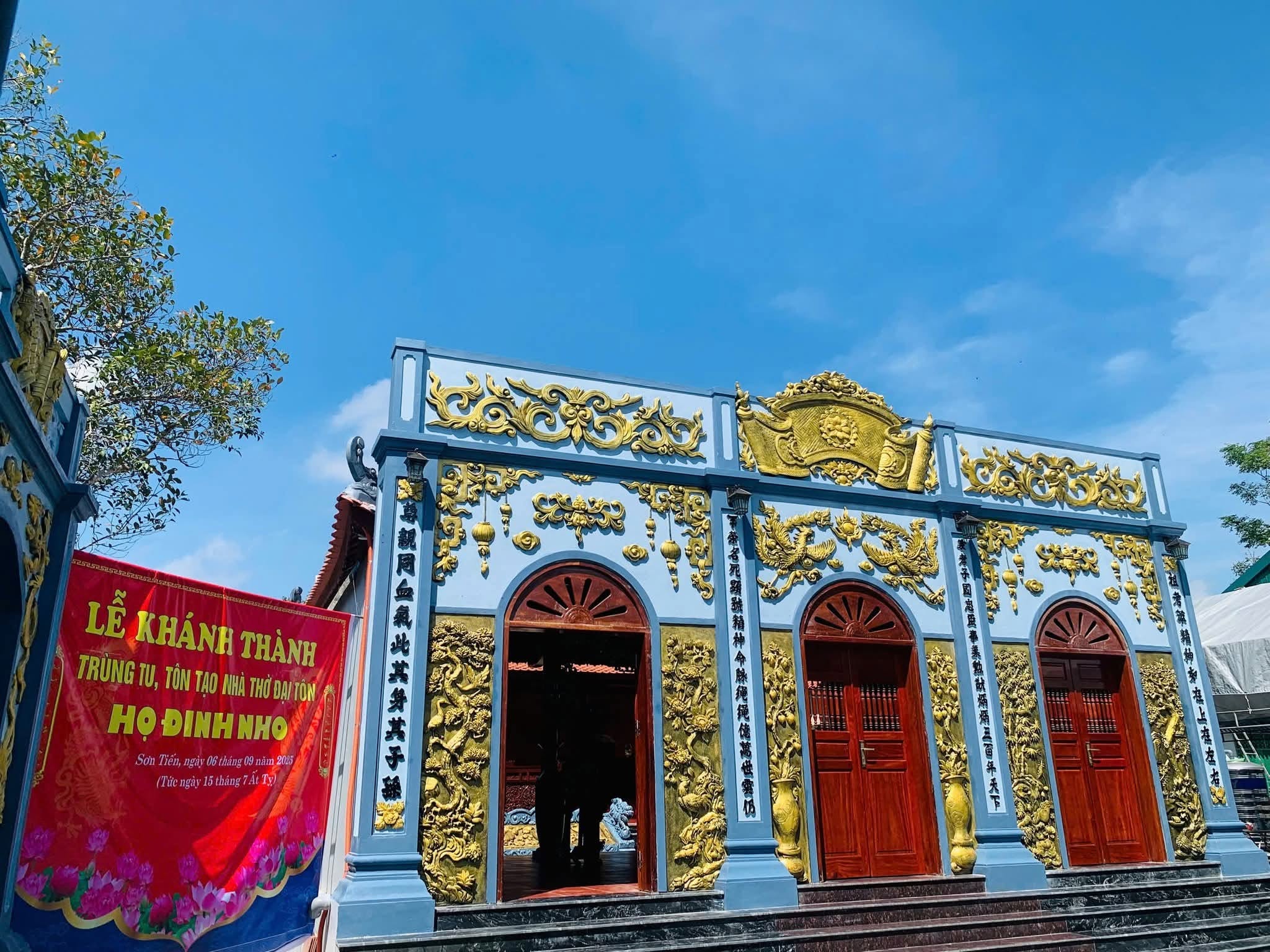
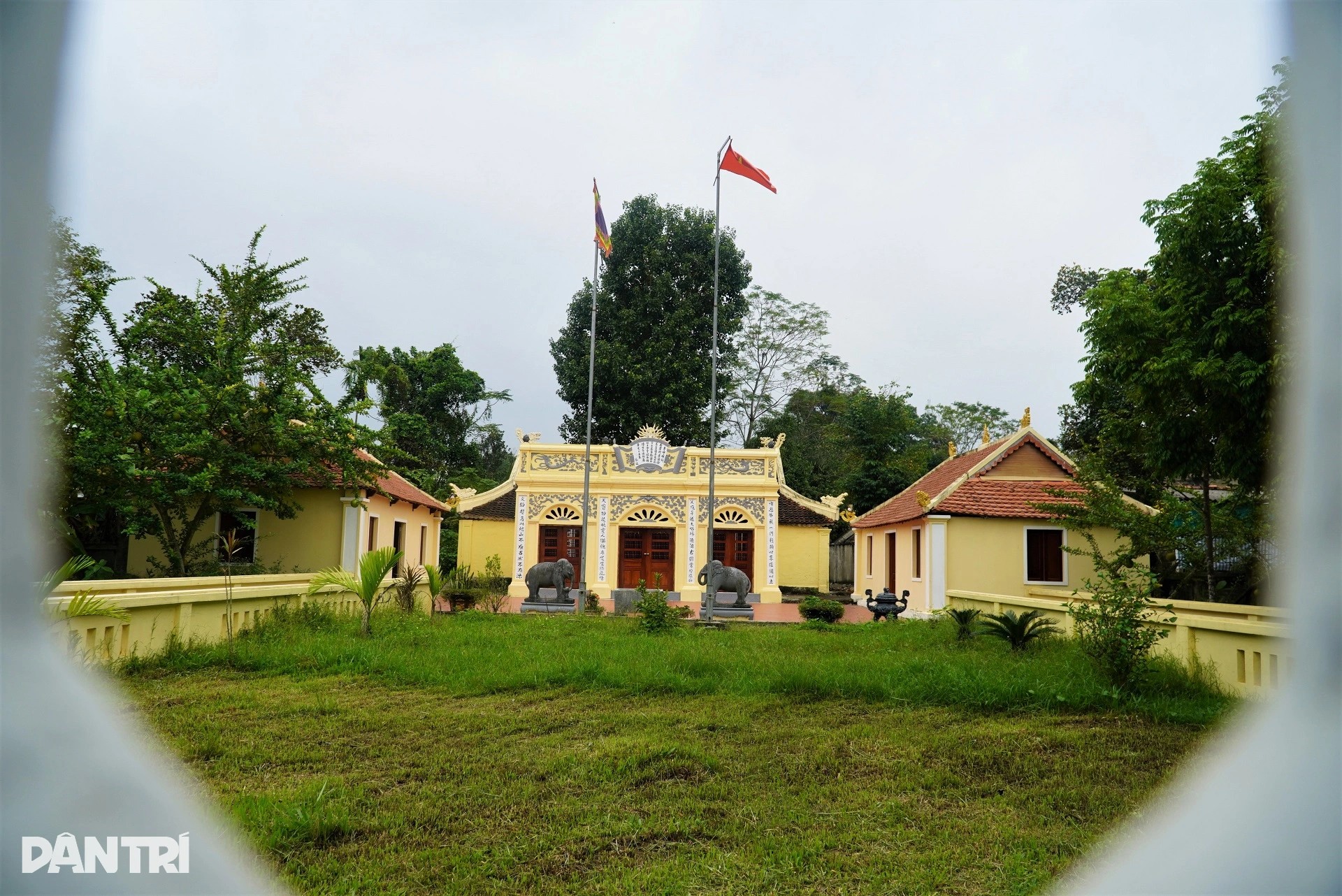

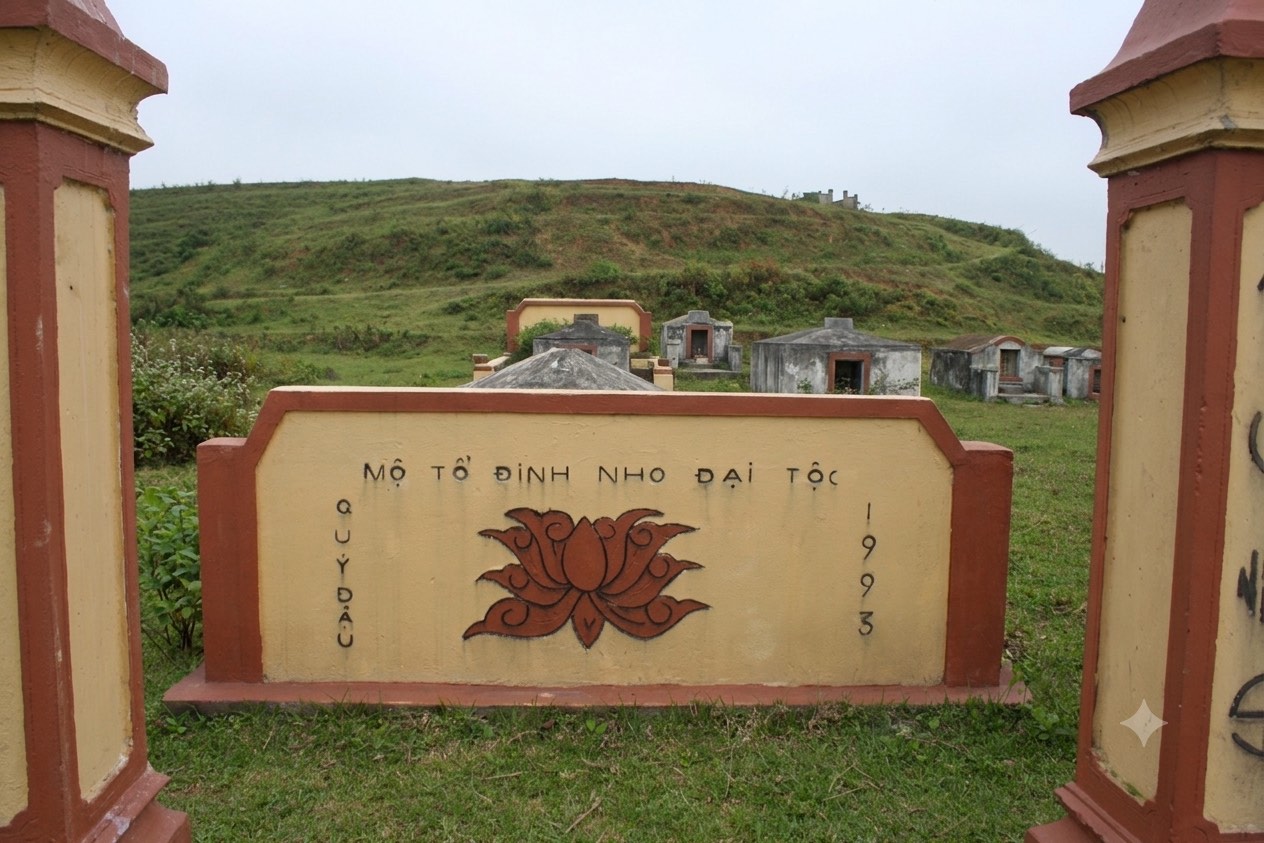


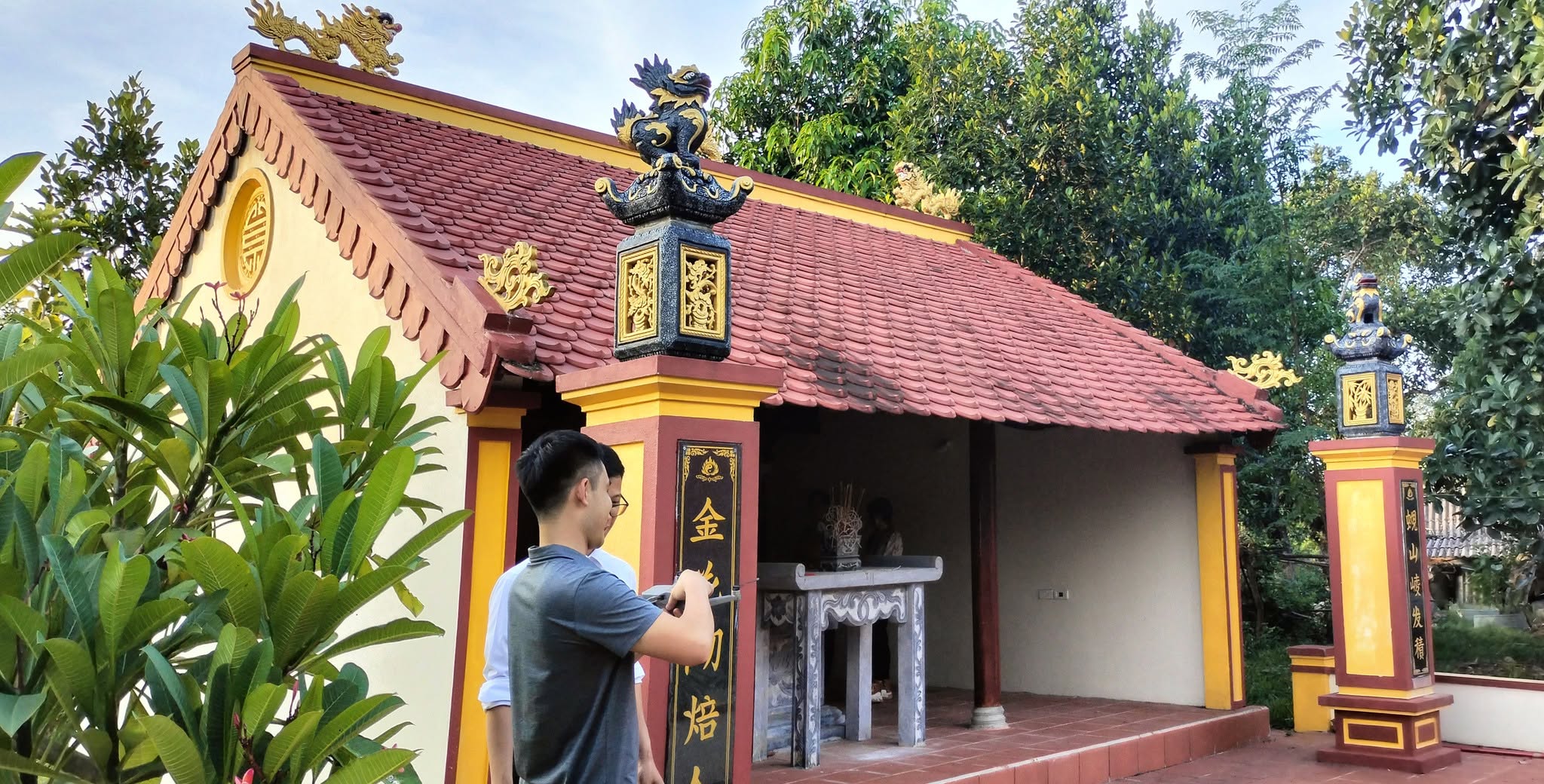
Of the 82 doctors' steles at the Văn Miếu, two bear the name of the Đinh Nho clan — father and son, thirty years apart. The map below shows the exact location of each stele.

1 Đinh Nho Công · Canh Tuất 1670 · stele no. 31 · 3rd from right, row 1 — 2 Đinh Nho Hoàn · Canh Thìn 1700 · stele no. 19 · 1st from right, row 2
Migration flows & places of memory on the map of Vietnam
From Gia Viễn (Ninh Bình) to Sơn Hòa (Hương Sơn): the movements of the lineage from the flight from the Mạc (1527) to the dispersed branches of today. Click a marker to display the place's card.
The long survival of the Hương Yên phổ tự
The genealogy crossed nearly three centuries of losses and restorations — a chain of fidelities here set out:
A decisive link: the original Hương Yên phổ tự having finally disappeared, it was the copy made of it by the doctor Đinh Nhật Thận, kept by the Thanh Liên clan, that allowed the primitive text to be recovered. In 2010, a delegation of ten members of the Thanh Liên clan, come to honour the founding ancestor, handed a photocopy of it to the Hương Sơn clan. The memory of a branch thus saved that of the trunk.
The gaze of Đặng Thai Mai
A descendant of the clan through his grandmother Đinh Thị Hoan, Professor Đặng Thai Mai left, on the Đinh Nho lineage, lines of measured lucidity that make a fine coda to this history.
"The Đinh clan is a great clan. It is said that, going very far back, one reaches the time of Đinh Tiên Hoàng, of Đinh Điền… The family temple still keeps the tablet, dated to the Lê, honouring the lady of fidelity, wife of Đinh Nho Hoàn, doctor, risen to the first or second rank, dead on embassy on the road to China…
For our generation today, all these accounts of a scholarly lineage, of mandarin successes, of death on the road of an embassy, are but pages from the history of the manners of a bygone feudal age. But across the centuries, the descendants of the Đinh clan have seen in them, beyond pride, a tradition of diligent study and the virtue the ancients called loyalty, uprightness and constancy."
Đặng Thai Mai, Memoirs (1985)
History of the Đinh Nho clan of Hương Sơn (Hà Tĩnh)
A lineage of scholars, mandarins and patriots — from the 16th century to the present day
Synthesis based on the clan genealogy (editions 2000–2020), the History of the Đinh Nho Clan by Đinh Tú Anh (2023) and the university dissertation of Nguyễn Văn Sô (University of Vinh, 2008). Established facts and hypotheses distinguished; corrections and contradictions flagged explicitly.
📚 Consult these sources in the Library · 🌳 Explore the full family tree
From the gia phả to the school of excellence
Đất nghèo nuôi chữ — a poor land that nourishes letters.
Hà Tĩnh saying
Ever since Đinh Nho Công earned his doctorate at the Canh Tuất examination (1670), the lineage has kept giving the country laureates: hoàng giáp Đinh Nho Hoàn (1700), Doctor Đinh Nho Điển (1875), hoàng giáp Đinh Văn Chấp (1913)… For three centuries, in a harsh land, learning was the wealth handed down from generation to generation.
That heritage became an institution. In 1991 the province founded the Hà Tĩnh School for the Gifted — now Trường THPT Chuyên Hà Tĩnh, one of Việt Nam's ten leading high schools. Among its builders was teacher Đinh Nho Kiểu, a founding pillar of the elite mathematics and physics streams, honoured in the school's annals as “the one who remains in our memory”.
The International Mathematical Olympiad gold medallists trained in Hà Tĩnh (2013, 2017) are the direct heirs of an ethic of effort forged over more than three hundred years by the region's great scholarly families — among them the Đinh Nho house of Hương Sơn.