The Đinh Nho
Lineage
Five centuries of memory — a book for the young
passing the examinations without end"
Before we begin…
You carry a name that has crossed nearly five hundred years. Before you, twenty generations bore it: farmers and scholars, soldiers and ambassadors, poets, courageous mothers, children who — like you today — were learning to read and wondering where they came from.
This little book is not a boring history textbook. It is rather a letter your ancestors are writing to you across time. It tells you who they were, what your name means, what they believed in, and what they hope from you.
You are not required to become a mandarin or a champion. Your forebears asked one thing only: that you be an upright and good person, proud of your roots, useful to others. The rest — the diplomas, the medals, the travels — is only a consequence.
Read without hurrying. And when you have finished, you will know something precious: you are not alone. A whole lineage walks behind you.
— For the children and grandchildren of the Đinh Nho lineage
I · The originsWhere do we come from?
Our story begins with kings, passes through a civil war, and takes root on the bank of a river in central Vietnam.
From the blood of emperors
Our family descends from the great Đinh lineage of Gia Viễn, in Ninh Bình province — the same region as Vietnam's first emperors. Our most distant forebears connect to General Đinh Điền (924–979), one of the four trusted lieutenants of Emperor Đinh Bộ Lĩnh, also called Đinh Tiên Hoàng.
Why does this matter? Because Đinh Bộ Lĩnh is the sovereign who, in 968, unified the country and founded the kingdom of Đại Cồ Việt — the first truly independent Vietnam after a thousand years of Chinese rule. The name Đinh is thus one of the oldest royal names in our history.
The flight and the new beginning
In the early 16th century, Vietnam was torn apart: the Mạc family had overthrown the Lê dynasty, and the country split. Our ancestor served the Lê. When his leader, the mandarin Lê Tuấn Mậu, was executed by Mạc Đăng Dung, our forebear was hunted in turn.
Around 1527, fleeing the turmoil, four brothers set out southward, to the land of Hoan Châu (today's Nghệ An and Hà Tĩnh). There they parted to found each a lineage. The eldest, Đinh Phúc Diên, continued on and settled around 1543–1546 at An Ấp / Sơn Hòa, in the district of Hương Sơn (Hà Tĩnh). It is there that our lineage is born.
Đinh Phúc Diên
A military officer, he received the title Tả Hiệu Điểm, Marquis of Công Tây for his help in restoring the Lê. But what mattered was not his rank: it was his character. The genealogy describes him as "diligent at work, living in sobriety, placing duty to the homeland and love of the people first." He cleared land, raised the banner "support the Lê, destroy the Mạc" alongside his friend Phạm Phúc Kính, and lived 93 years.
Every year, on the 9th day of the first lunar month, the whole family gathers to honour his memory. It is the most important day of the year for the lineage.
"The Đinh Nho lineage is a great, illustrious and aristocratic lineage of Hương Sơn and the land of Nghệ… It has produced many famous figures, in the examinations, in the mandarin career and in arms." — Hà Tĩnh newspaper, 17 April 1999
II · IdentityWhat does our name mean?
A Vietnamese name reads like a little sentence. Ours says, in two words: "the family of scholars."
Đinh — the family name
This is the clan name, the one passed from father to son. Đinh is one of the oldest names in Vietnam: it is that of the first imperial dynasty. To bear it is to inherit a history that touches the very roots of the nation.
Nho — the Confucian scholar
The character 儒 (Nho) means "scholar," "learned one of the school of Confucius." This word, placed in the middle of the name, became the mark of our lineage. It is a programme for life: to study, to cultivate one's mind, to serve the good.
Put the two together, and Đinh Nho tells everything: a family of ancient blood that chose the path of study and virtue. This "middle name" (in Vietnamese tên đệm) recurs generation after generation — Đinh Nho Công, Đinh Nho Hoàn, Đinh Nho Điển… — like a thread of gold sewn across the centuries.
When someone asks your name, remember: you are not only saying what you are called.
You are announcing where you come from and what you aim for.
III · The compassConfucianism, simply
The word "Nho" in your name comes from an idea born 2,500 years ago. Here, without jargon, is what it means.
Long ago, in China, a master named Khổng Tử (Confucius, ~551–479 BC) asked himself a simple question: "How can we live together, in peace and with justice?" His answer is not a religion with gods to pray to, but rather a wisdom for conducting oneself well — in the family, at school, in society.
This thought became, for centuries, the heart of Vietnamese culture. It is what guided our ancestors. At its centre, two great values you may already know:
Hiếu — filial piety
To love, respect and care for one's parents and elders; to honour those who came before us. It is the first of the virtues: everything begins there.
Trung — loyalty
To be faithful: to one's word, to one's friends, to one's community, to one's country. To hold firm, even when it is hard, even when no one is watching.
Confucius summed up the art of living well in five qualities to cultivate throughout one's life. Here they are — learn them, they are the five colours of your heritage:
In old Vietnam, one did not become important through wealth or birth, but through the examinations. Very difficult exams, open (in theory) to all, allowed the best students to serve the State. There were three great levels:
Thi Hương · regional examination → title of Cử nhân / Hương cống Thi Hội · metropolitan examination Thi Đình · palace examination, before the king → title of Tiến sĩ (doctor)
The names of the doctors were engraved in stone, on the steles of the Temple of Literature (Văn Miếu) in Hanoi — where they can still be read today. To succeed was to inscribe one's name in the memory of the country. That is why, in our family, the words were endlessly repeated: "study diligently." You will soon read the names of our own engraved there.
"Advancing, be a scholar of honour; withdrawing, be an honest farmer." Precept of the lineage — 進為義士 · 退為良農 (tiến vi nghĩa sĩ, thoái vi lương nông)
Translation for today: when you succeed, put your knowledge at the service of what is right; when you have no post, remain an honest and proud worker. In both cases, you can be counted on.
IV · The role modelsOur great figures
Here are a few forebears whose stories are still told. They are not perfect — they are inspiring.
Đinh Nho Công
For six generations, the family had only one son per generation and no laureate. Everything changed with him: at 34, in 1670, he became the lineage's first Tiến sĩ (doctor). He was a censor (high magistrate) renowned for his integrity. One story shows it well: sent to inspect the prisons, he discovered a man unjustly held and freed him — a gesture that, years later, would change the family's destiny (you will see this with Lady Phan Thị Viên).
He had 12 children, including 6 sons, and was later honoured under the name Anh Nghị Đại Vương, "the talented and resolute great dignitary."
Đinh Nho Hoàn
Son of the former, he is probably the most famous of our ancestors. Brilliant very young, he became Hoàng Giáp (second-rank doctor) at 30, in 1700. Appointed governor of Cao Bằng, he cleared the rivers, lightened taxes and controls; in gratitude, the Chinese merchants raised a stele of thanks to him, the "Stele of Just Administration."
In 1715, the king sent him on an embassy to China. He never returned: he fell ill and died at Yên Kinh (Beijing) in early 1716, at 45. On the road, he composed a collection of 103 poems (Mặc Ông sứ tập). He had also had a stone bell cast, engraved with a magnificent thought:
"The sound of the bell is clear and measured, gentle yet high and powerful, in the image of the elevation of man. That is why, loving this sound, I had it cast… to strengthen my resolve."
Phan Thị Viên — "Lady Tiết phụ"
She was the daughter of the man Đinh Nho Công had saved from prison. To repay that debt, her family gave her in marriage to the saviour's son, Đinh Nho Hoàn. Married at 16, learned and gifted, she wrote ten poems for her husband as he left on embassy.
When the news of her husband's death arrived, she first hid her grief so as not to worry her family. Then, after the return of the coffin, she composed poems of farewell and chose to die to follow him. The king awarded her the title "Tiết phụ" (faithful woman). The famous writer Đoàn Thị Điểm drew on her life to write the tale "The Valiant Woman of An Ấp." Her story is beautiful and grave — it speaks to us of loyalty and strength, but also of the value of every life.
Đinh Nho Côn
Brother of Đinh Nho Hoàn, he was first in the regional examination (Giải nguyên)… then gave up the brush for the sword! Having become a military commander, he received the title Marquis of Hương Nghĩa. His descendants settled at Thanh Liên (Thanh Chương, Nghệ An), where they founded an entire branch of the family. His motto might be: one can serve the country as much through knowledge as through courage.
Đinh Nhật Thận
Great-grandson of Đinh Nho Côn, he became a doctor in 1838 and was the intimate friend of the famous rebel poet Cao Bá Quát. Implicated in a revolt, he was imprisoned. It was in captivity that he wrote his masterpiece, the Thu dạ lữ hoài ngâm ("Nostalgic Lament of a Traveller on an Autumn Night").
The great professor Đặng Thai Mai ranked it among the four most beautiful "laments" in all classical Vietnamese literature — alongside the Chinh phụ ngâm, the Cung oán ngâm khúc and the Tale of Kiều by Nguyễn Du. In other words: a summit of our language, written by one of our own.
Đinh Nho Điển
A doctor in 1875 under the reign of Tự Đức, he served as a high magistrate. When the French troops seized Thừa Thiên province, he starved himself to death. The Nguyễn dynasty had a temple built in his honour — today classified a provincial historical relic.
The Four Phúc thần
Here is an extraordinary and very rare fact in all of Vietnamese history: in one and the same family, four people were raised by kings to the rank of tutelary deities (Phúc thần) — that is, protective spirits venerated at the temple. They are:
Đinh Nho Công — the father Đinh Nho Hoàn — his son Phan Thị Viên — his daughter-in-law Đinh Nho Côn — his son
"Above, they protect the homeland; below, they shelter the people.
A single house, four tutelary deities: what glory!" — Eulogy by the licentiate Đinh Nho Quang (14th generation)
They are still honoured today at the Gôi Vỵ temple (at Sơn Hòa, Hương Sơn). This is not "superstition": it is a way of saying thank you and of keeping alive the memory of those who brought honour to the family and the country.
V · The structureThe tree and its branches
A single root, planted at Hương Sơn. Then, little by little, great branches spreading across the whole country.
For the first seven generations, the lineage was "độc đinh": a single son carried the name in each generation. A very fine thread, but one that never broke. Here are the first links:
Đinh Phúc Diên
Comes from Gia Viễn (Ninh Bình), settles at Hương Sơn around 1543–1546. Marquis of Công Tây.
Đinh Phúc Trường
Faithful to his father's teachings, he studied under Master Trần.
Đinh Phúc Bảo
Đinh Chính Tính
Đinh Phúc Khánh
Đinh Hữu Luân
It is said that he helped a Chinese merchant in distress, who in return taught him the art of feng shui. It was he who chose the site of the ancestral tombs.
Đinh Nho Công
First doctor of the lineage (1670). With him, the "single thread" becomes a tree: he had 6 sons, and the family flourished at last.
The 8th generation
The sons of Đinh Nho Công gave rise to the four great branches of the lineage (below).
The four branches
Đinh Nho Trạch
Eldest son of Nho Công. A licentiate at 18, he was likened to an "Immortal." His descendants, at Hương Sơn, are marked "A" in the genealogy.
Đinh Nho Thận
Another son of Nho Công, at Hương Sơn. His descendants are marked "B." (It is from this branch that, later, the scholar Đinh Xuân Lâm comes.)
Cương Gián (Nghi Xuân)
Founded by Đinh Nho Thường, who settled at Cương Gián, in the district of Nghi Xuân (Hà Tĩnh).
Thanh Liên (Thanh Chương)
Founded by General Đinh Nho Côn, at Thanh Liên (Nghệ An). It is the branch of the poet Đinh Nhật Thận.
Today, the descendants live throughout Vietnam — and even abroad. If you read these lines far from the country, know that you belong to one of these branches. To find out which, ask your parents or grandparents: it is a lovely conversation to have.
VI · The new guardThe lineage today
Tradition is not a museum. It continues — including with young people your age.
After the emperors and the mandarins, the family went on producing remarkable women and men, right up to our own time. Here are a few:
Prof. Đinh Xuân Lâm
Born at Sơn Tân (Hương Sơn), he became one of the most respected historians in Vietnam — one of the legendary "Four Pillars" of Vietnamese history. Honoured as a "People's Teacher," he trained thousands of students and published more than 570 works. He was still working past the age of 80.
Đinh Xuân Vịnh
Trained under colonial rule, he was a legendary devourer of books. For more than half a century, alone, he composed by hand a veritable encyclopaedia of Vietnam: 40 school notebooks, nearly 40,000 entries, which he titled Việt Nam Văn Hiến ("the civilization of Vietnam"). Part of it was published under the title Sổ tay địa danh Việt Nam (754 pages); his work received the First Prize of the Vietnam Folk Arts Association (1994), was proposed for the Hồ Chí Minh Prize, and the State awarded him the Labour Medal.
Đinh Nho Liêm
From a very poor family (they wove cloth to live), he became, through sheer work, ambassador to several countries and then first Vice-Minister of Foreign Affairs. The living proof of the family precept: it is not the means at the start that decide, but perseverance.
Đinh Nho Hưng
The family's diplomatic vocation continues. Having joined the Ministry of Foreign Affairs in 1999, he presented his credentials to King Harald V on 1 June 2023, becoming Vietnam's ambassador in Oslo. After Đinh Nho Liêm, it is a new Đinh Nho who represents the country among the nations.
Thích Minh Châu (Đinh Văn Nam)
From a related Đinh lineage (Nghi Lộc) that counted four generations of doctors, he became a great master of Vietnamese Buddhism and the translator of the Pali Canon into Vietnamese, after twelve years of study in Ceylon and India. A spirit of knowledge and peace.
Đinh Thị Hoa
Daughter of Đinh Nho Liêm, she was one of the very first Vietnamese women to earn an MBA from Harvard Business School. Back home in 1994, she founded the Galaxy (Thiên Ngân) group and became the pioneer of private cinema in Vietnam. The path of excellence is no longer reserved for the examinations of old — nor for boys alone.
Đinh Nho Tâm
A full scholar at Cambridge (mathematics, Trinity College — Newton's college), he then earned an MBA from Stanford, where he was the first Vietnamese in decades to receive the Arjay Miller award (top 10% of his cohort). Back home, he is today chief financial and investment officer of the Galaxy group. His motto, borrowed from Nike: "Just do it" — get started.
Đinh Nho Kiệt
Here is a family member who could be your cousin! Born in 2010, he is already a chess champion. In 2023, at the Southeast Asian Youth Chess Championships, he won six gold medals — including by moving up to play against older children. A year earlier, he had been world champion in his age category.
The lineage of scholars of old has today its champions, its scientists, its artists. Tomorrow, perhaps, it will be you.
And so many others today
Đinh Nho Hào — professor of mathematics at the Institute of Mathematics, president of its scientific council, a recognized specialist in "inverse problems."
Đinh Nho Minh — grandson of Đinh Nho Liêm; a full scholar at Tufts University in international relations, he pursued graduate studies at Harvard and is today a doctor. His dream, like his grandfather's: to serve his country's diplomacy. With him, a whole 18th generation is writing, at this very moment, the next chapter of this story.
In the 19th century, Đinh Thị Hoan — sister of the doctor Đinh Nho Điển — married a scholar of the Đặng family. Her grandson was the great professor Đặng Thai Mai, Minister of Education and first director of the Institute of Literature. And Đặng Thai Mai's eldest daughter, the historian Đặng Bích Hà (1928–2024), married in 1946 General Võ Nguyên Giáp — the legendary victor of Điện Biên Phủ.
Thus, through the women, the blood of the Đinh Nho lineage joins one of the greatest figures in all of Vietnamese history.
And between these great names: doctors, engineers, teachers, soldiers, farmers, mothers. Many sacrificed themselves for the country — some families count several martyrs, and one forebear received the title of "Heroic Vietnamese Mother." All, in their own way, kept the promise of the Đinh Nho name.
VII · The legacyYour duties
Three centuries ago, Đinh Nho Hoàn had a letter to his descendants engraved in stone — and so to you. Here it is, translated for today.
Before leaving for his embassy to China (from which he would not return), Đinh Nho Hoàn raised a stele bearing this family precept (gia huấn). It is our most precious text: a roadmap for becoming a good person.
"To my descendants"
- Be loyal and respectful of your own.trung hiếu — faithful to your word, loving toward your parents
- Stay simple, honest and generous of heart.phác hậu
- Be upright and thrifty; be happy even without riches.thanh kiệm lạc bần
- If you succeed, put your knowledge at the service of what is right.tiến vi nghĩa sĩ
- If you have no post, be an honest and proud worker.thoái vi lương nông
- Be neither arrogant nor dissolute.vật kiêu dâm
- Do not offend your elders or your superiors.vật phạm thượng
- Do not be quarrelsome or litigious.vật tranh tụng
- Do not give yourself to gambling.vật đổ bác
These nine sentences come down to one simple idea: be a good person, whatever happens. Concretely, in your life today, here is what that can mean:
Learn
Give yourself fully to your studies and your passions. Knowledge is the treasure no one can take from you — and the finest tribute to your scholar forebears.
Honour your own
Listen to your parents and grandparents, take care of them, remember their stories. Ask them to show you the ancestral altar and to explain the day of commemoration to you.
Act with uprightness
Tell the truth, keep your promises, defend the weakest. The family's reputation for integrity was built gesture by gesture — do not break it.
Keep your roots
Learn to write your name, know your branch, know where you come from. And one day, pass on this booklet — completed with your own story — to those who come after you.
"The descendants of the Đinh Nho lineage vow to remain united all their lives, to counsel and help one another, and to follow the luminous virtue of the ancestors — so as not to be ashamed before their forebears." — Oration of the lineage, spoken each year at the ceremony
VIII · The mapPlaces of memory
If you return one day to the homeland, here are the places where the soul of the family dwells.
The lineage temple (Từ đường)
At Đồng Vực, commune of Sơn Hòa, district of Hương Sơn (Hà Tĩnh). It is the heart of the family: the two Hương Sơn branches render the ancestral cult there together. They gather there each year on the 9th day of the 1st lunar month.
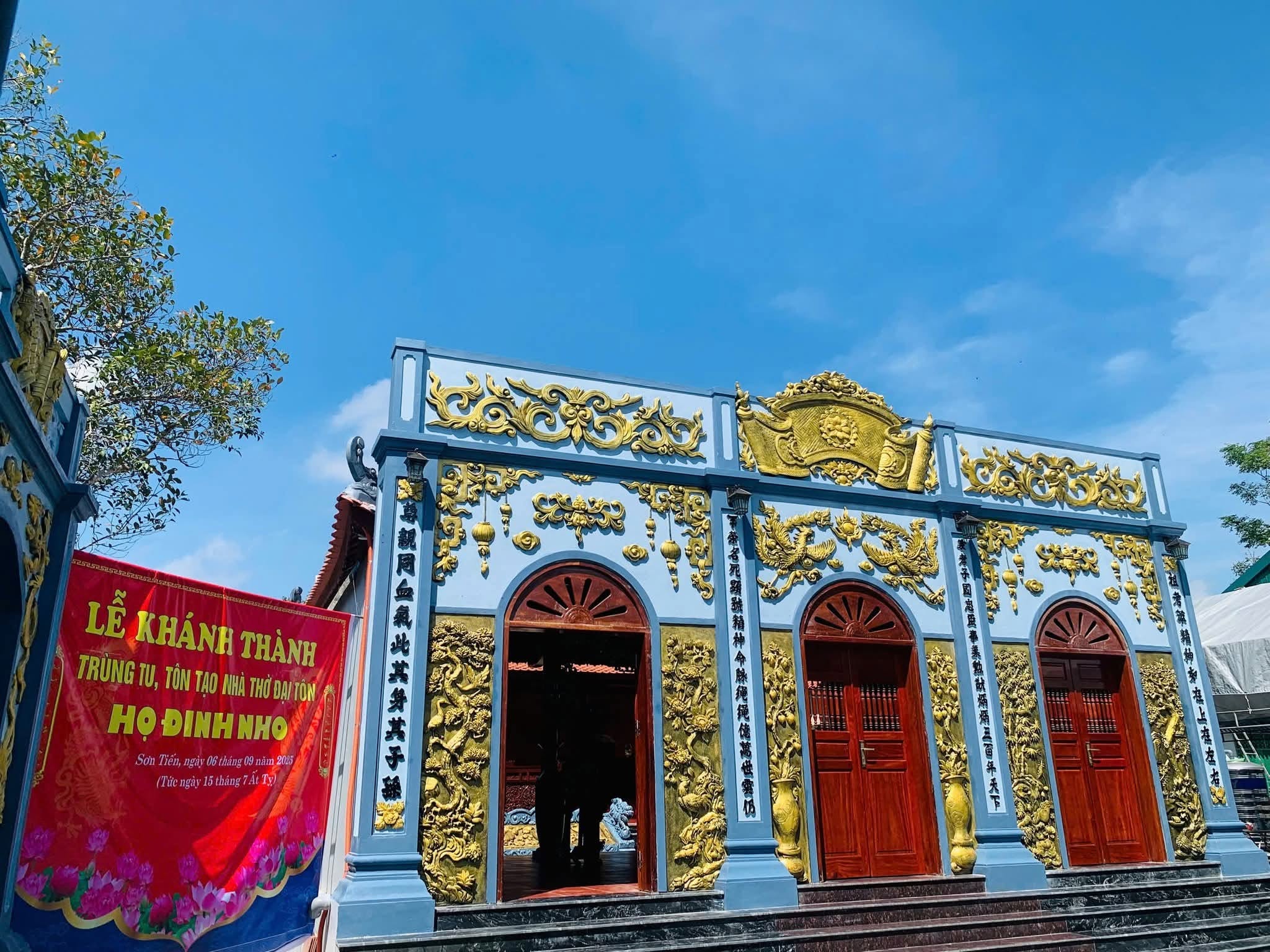
The Gôi Vỵ temple (Gôi Mỹ)
At Sơn Hòa, Hương Sơn. It is there that the family's Four Phúc thần and the Faithful Woman, Phan Thị Viên, are honoured. The temple survived the destructions because it served for a time as a commune hall. The famous stone bell of Đinh Nho Hoàn is also kept there.
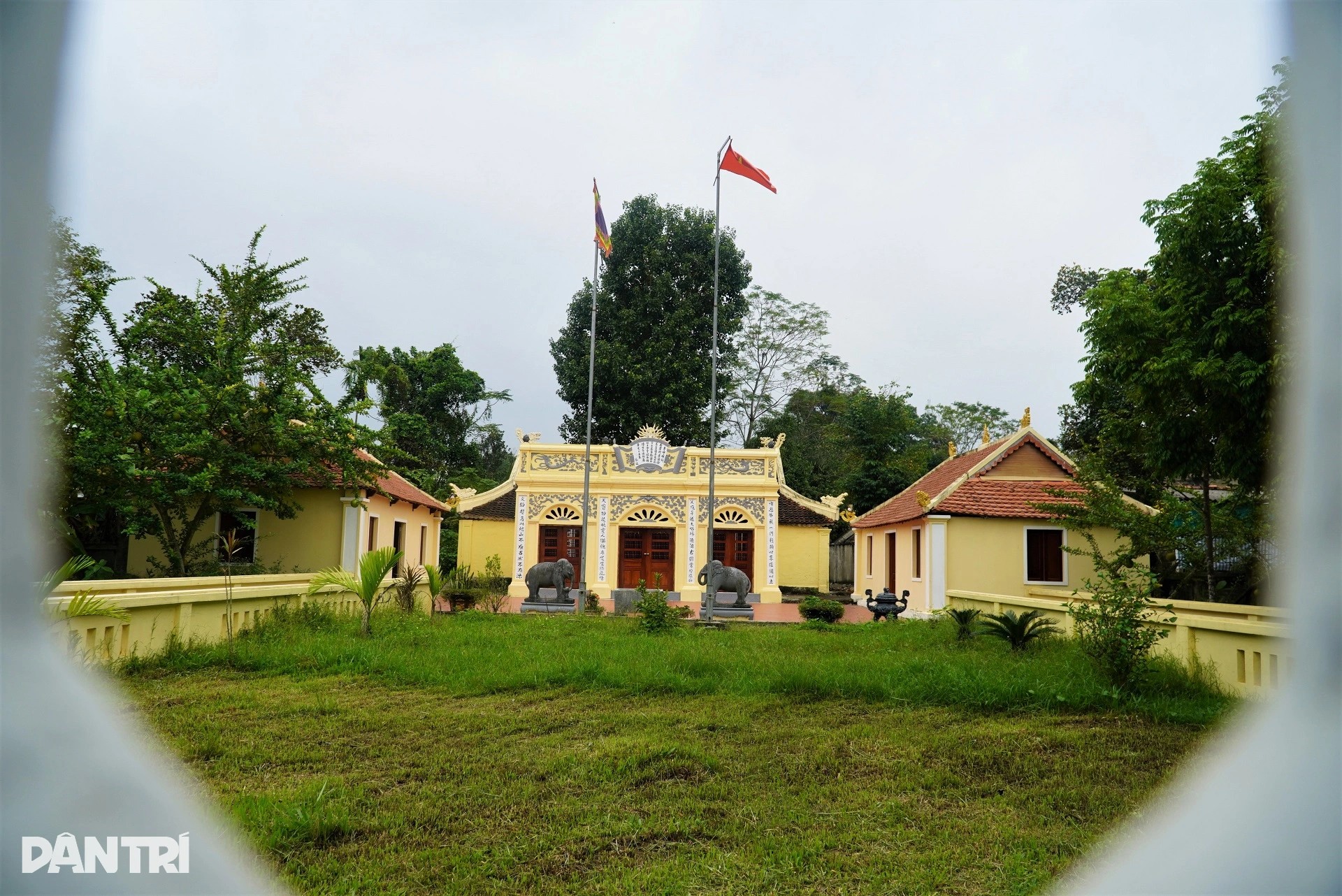
The Áng Phần funerary complex
At Sơn Hòa: the largest funerary estate of the lineage, gathering 16 tombs, including that of the founding ancestor. Other complexes exist: the Kim Hoa mausoleum, Trai Sơn, Lòi Chim Chim.
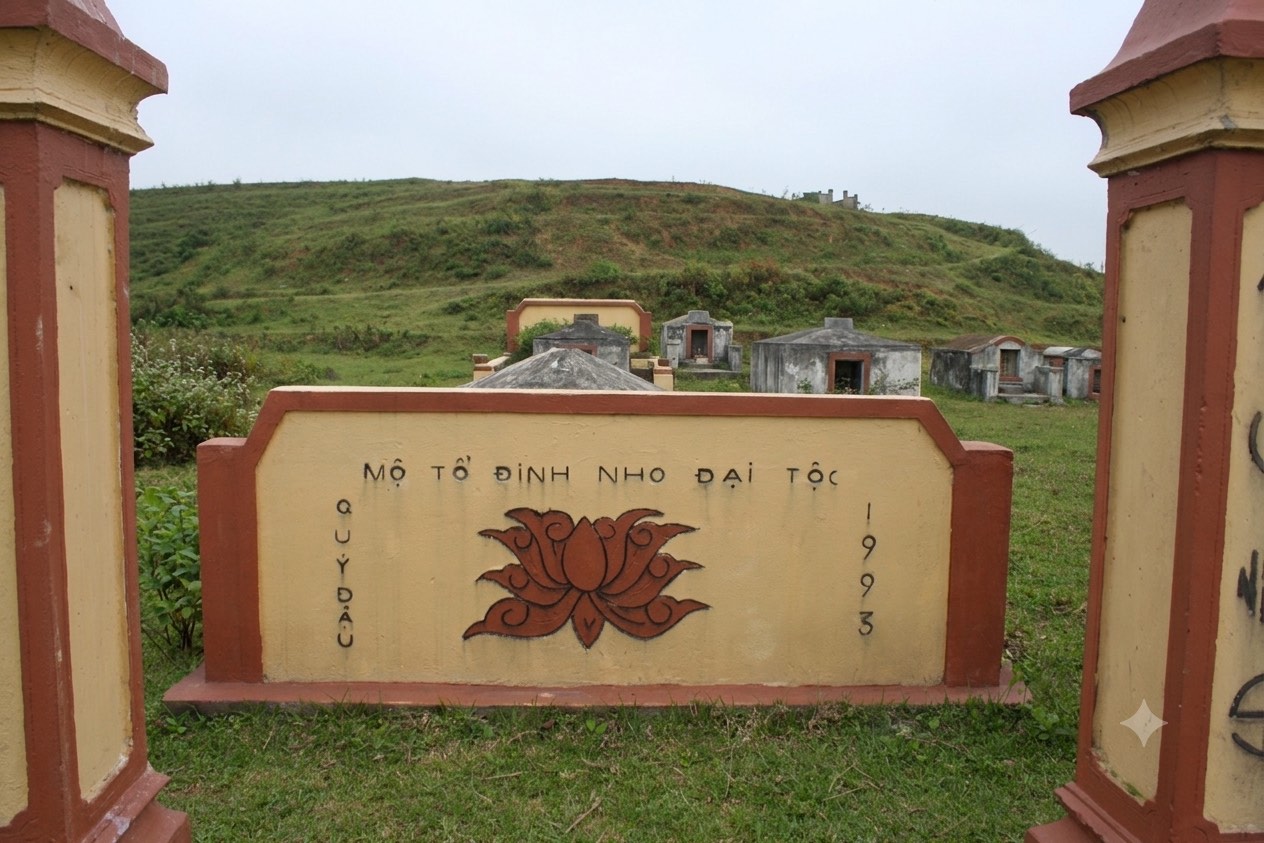
The tomb of the Ancestral Mother
That of Lady Hoàng Quý, the mother of the four brothers who fled southward, at Nghi Long (Nghi Lộc, Nghệ An). It is said that, on the night of her burial, a storm covered her grave with earth: the inhabitants held it to be a "tomb buried by Heaven," most sacred.

The Temple of Literature, in Hanoi
Far from Hương Sơn, but essential: on the steles of the Văn Miếu – Quốc Tử Giám in Hanoi are engraved the names of Đinh Nho Công and his son Đinh Nho Hoàn — father and son, both received as doctors, separated by thirty years. If you visit Hanoi, go and look for them: they are the names of your ancestors, in the stone.
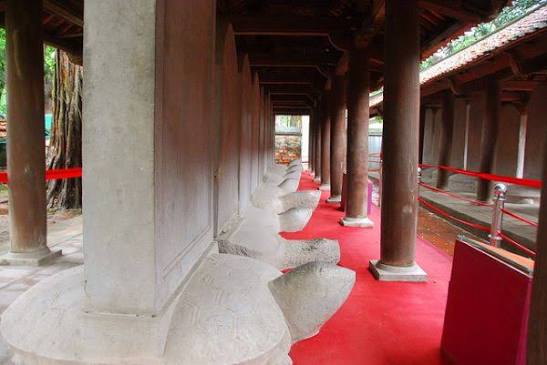
Of the 82 doctors' steles at the Văn Miếu, two bear the name of the Đinh Nho clan — father and son, thirty years apart. The map below shows the exact location of each stele.

1 Đinh Nho Công · Canh Tuất 1670 · stele no. 31 · 3rd from right, row 1 — 2 Đinh Nho Hoàn · Canh Thìn 1700 · stele no. 19 · 1st from right, row 2