The Đinh Nho
Clan
Five centuries of memory — a booklet for young people
Before we begin
You carry a name that others carried before you for nearly five hundred years. Some twenty generations have followed one another: farmers and scholars, soldiers and ambassadors, poets, mothers, children who, like you, were learning to read and wondering where they came from.
This booklet tells you who these ancestors were, what your name means, what they believed in and what they wanted to pass on. Everything it tells comes from documents: the clan's register, steles, poems, history books. When these documents do not all say the same thing, the booklet points it out to you with this sign: ⚠︎.
Read without hurrying. You will see that you are not alone: a whole clan walks behind you.
I · The originsWhere do we come from?

The roots of the Đinh name
According to the clan's register, our family comes from the Đinh clan of Gia Viễn, in Ninh Bình province, the region of the first kings of independent Vietnam. Tradition links our distant ancestors to General Đinh Điền (924–979), one of the companions of Emperor Đinh Bộ Lĩnh, also called Đinh Tiên Hoàng; other accounts link them directly to the emperor's family ⚠︎.
Đinh Bộ Lĩnh reunified the country in 968 and founded the kingdom of Đại Cồ Việt, the first independent Vietnamese state after the long period of Chinese rule. Be careful: bearing the name Đinh does not make anyone a descendant of the kings. Many Đinh families are not related to one another.
The flight and the new beginning
In the early 16th century, the country was torn apart: the Mạc family had seized power from the Lê kings. According to one version recorded in the register, our ancestor took the side of the Lê, together with the mandarin Lê Tuấn Mậu; when the mandarin was executed, our ancestor had to flee.
The family set off southward, to the land of Hoan Châu (today Nghệ An and Hà Tĩnh). The documents do not all say how many brothers made the journey, or where each one settled ⚠︎. Đinh Phúc Diên settled around 1543–1546, perhaps as early as 1530 ⚠︎, at An Ấp, in the district of Hương Sơn (Hà Tĩnh). The hamlet is now part of the commune of Sơn Tiến (it used to be called Sơn Hòa). That is where our clan was born.
Đinh Phúc Diên
An officer, he received the title of Tả Hiệu Điểm Công Tây Hầu. The register describes him as “diligent in his work, living simply, placing duty to the homeland and love of the people first”. He cleared land and joined forces with Phạm Phúc Kính, the ancestor of the neighbouring Phạm clan, to support the Lê. He lived to 93, by the Vietnamese way of counting age (you are already one year old at birth).
Every year, on the 9th day of the first lunar month, the family gathers to honour his memory: it is the most important day of the year for the clan.
Where does this come from? The clan's register (2020 edition, part A), the old genealogy Hương Yên phổ tự and Đinh Tú Anh's book (2023). The dates of arrival, the number of brothers and the reason for the title vary from one document to another: see the History of the Clan page and its register of discrepancies (D-H01, D-H04, D-H05, D-H06).
II · IdentityWhat does our name mean?

Đinh — the family name
This is the clan name, passed down from father to son. Đinh is one of the oldest names in Vietnam: it is the name of the first independent dynasty. Many Đinh families bear it without being related.
Nho — the scholar
The character 儒 (Nho) means “scholar”, someone who studies the books of the school of Confucius. Placed between the family name and the given name (it is the tên đệm, the middle name), it recurs generation after generation: Đinh Nho Công, Đinh Nho Hoàn, Đinh Nho Điển… We do not know exactly when it first appeared; we may suppose that it dates from the generation of Đinh Nho Công, in the 17th century.
Put the two together: Đinh Nho means a family that chose the path of study. When someone asks your name, you are also saying where you come from.
Where does this come from? The clan's register and the History of the Clan page (chapter II).
III · The compassConfucianism, simply

About 2,500 years ago, in China, a master named Khổng Tử (Confucius) asked himself a simple question: how can we live together, in peace and with justice? His answer is not a religion with gods to pray to: it is a way of behaving well, in the family, at school and in society. This way of thinking guided Vietnam for centuries, and our ancestors along with it. Two values hold an important place in it:
Hiếu, filial piety
To love, respect and help your parents and elders, and to honour those who came before us.
Trung, loyalty
To be faithful to your word, to your friends, to your community and to your country.
Confucius also spoke of five qualities to cultivate all your life (the ngũ thường):
Why study mattered so much
In the Vietnam of old, people could serve the State by passing the examinations. These very difficult exams were, in principle, open to everyone. There were three main levels:
- Thi Hương, the regional examination, which gave the titles of tú tài or cử nhân (before the Nguyễn, people said hương cống);
- Thi Hội, the capital examination;
- Thi Đình, the palace examination, held before the king, which gave the title of tiến sĩ (doctor).
The names of the doctors were engraved on the steles of the Temple of Literature (Văn Miếu) in Hanoi, where they can still be read. Two of these steles bear names from our clan: you will find them again in chapter VIII.
“When you go forward, be a man of duty; when you withdraw, be an honest farmer.” 進為義士 · 退為良農 (tiến vi nghĩa sĩ, thoái vi lương nông) — Precept engraved by Đinh Nho Hoàn in 1715.
In other words: when you have a responsibility, put what you know at the service of what is right; when you have none, remain an honest worker. Either way, people can count on you.
Where does this come from? For the precept: the old genealogy (Hương Yên phổ tự, Đinh Nho Dật's copy, p. 37). For Confucianism: the site's Confucian doctrine page.
IV · The role modelsOur figures

Here are a few ancestors whose stories the clan still tells. They were not perfect; they are remembered for what they did.
Đinh Nho Công
For six or seven generations ⚠︎, the family had only one son as heir in each generation. Each generation passed the regional examinations, but none reached the doctorate. Đinh Nho Công had to leave school to work in the fields for ten years, then went back to his studies. In 1670, at 34, he became the clan's first doctor (tiến sĩ).
He was a censor, a magistrate whose task was to keep a check on officials. Sent to inspect the prisons, he found a man who had been wrongly imprisoned and had him released; you will meet this man again with Phan Thị Viên. He had twelve children, including six sons. After his death, he was honoured under the name Anh Nghị Đại Vương, “the talented and resolute great dignitary”.
Đinh Nho Hoàn
The son of the ancestor above, he lost his mother when he was three. He passed as Hoàng giáp, a doctor of the second rank, in 1700, at 30. Appointed governor of Cao Bằng, on the northern border, he had the river cleared for boats, the inspections shortened and the taxes lowered. The Chinese merchants raised a stele of thanks to him, the Đức chính bi, “stele of good administration”.
In 1715, the king sent him on an embassy to China. He fell ill and died during the journey, at the beginning of 1716 according to most documents ⚠︎. Historians disagree about where: before reaching Beijing, after the mission, or on the way back ⚠︎. On the road, he wrote more than a hundred poems, which his son-in-law gathered in the Mặc Ông sứ tập (the books give between 103 and 155 ⚠︎).
He had also had a stone gong carved, a khánh, which he named Mặc Trai, his scholar's name. He had these words engraved on it: “The sound of the gong is clear and rhythmic, light and bright, high and resonant, as if it had the elevation of man. And so, loving this sound, I had it made… to strengthen my resolve.” This stone gong is still at the Gôi Vị temple.
Phan Thị Viên
She was the daughter of the man Đinh Nho Công had got out of prison. According to the clan's account, her mother one day recognised Đinh Nho Hoàn and reminded him of what her family owed his father; Phan Thị Viên then became his second wife. She was sixteen ⚠︎. An educated woman, she wrote ten farewell poems when her husband left on his embassy; three have survived.
When her husband's body was brought back home, she took her own life to follow him. An old official collection says she was nineteen ⚠︎. At that time, the court honoured widows who stayed faithful to their husbands, sometimes even in death: the king gave her the title of “Tiết phụ” (faithful wife) and had the Gôi Vị temple built for her. The writer Đoàn Thị Điểm drew on her story for a tale, “The Valiant Woman of An Ấp”.
Today, we do not see her act as an example to follow. We keep the memory of her talent, her faithfulness and her youth, and we know that every life matters. If this story, or any other, makes you sad or weighs on you, talk about it with an adult you trust.
Đinh Nho Côn
Half-brother of Đinh Nho Hoàn and the youngest of the six sons, he was, according to the 2023 book, first in the regional examination (Giải nguyên). He then became a district magistrate, and later a military commander, with the title of Marquis of Hương Nghĩa. The old genealogy remembers one precise act of his: by going back over the register of the men of his canton, he had the number of young men sent to the army reduced by more than thirty. His descendants settled at Thanh Liên (Thanh Chương, Nghệ An) and founded a branch of the clan there.
Đinh Nhật Thận
Great-grandson of Đinh Nho Côn, he became a doctor in 1838. A friend of the poet Cao Bá Quát, he was suspected of having supported Cao Bá Quát's revolt of 1854 and was held in Huế; it was there that he wrote the Thu dạ lữ hoài ngâm (“Lament of a Traveller on an Autumn Night”). According to the clan's register, Professor Đặng Thai Mai counted this poem among the four finest laments of classical Vietnamese literature, alongside the Chinh phụ ngâm, the Cung oán ngâm khúc and the Truyện Kiều.
Đinh Nho Điển
Having become a doctor in 1875, he served as a high official in Huế. After the treaties of 1883–1884, which placed the country under a French protectorate, he refused to serve. He died soon after: some documents say he stopped eating, others that he fell ill. In 1899, King Thành Thái honoured his memory; his temple was classified as a provincial historical relic in 2023.
The four tutelary spirits (Phúc thần)
In one and the same family, four people were raised by the kings to the rank of phúc thần, tutelary spirits honoured at the temple:
- Đinh Nho Công — the father
- Đinh Nho Hoàn — his son
- Phan Thị Viên — his daughter-in-law
- Đinh Nho Côn — his other son
“Above, they protect the homeland; below, they shelter the people. One single house, four tutelary deities: what glory!” — Eulogy composed by Đinh Nho Tĩnh (13th generation).
They are still honoured at the Gôi Vị temple, in Hương Sơn. It is a way of saying thank you and of keeping alive the memory of those who served their family and their country.
Where does this come from? The old genealogy (Hương Yên phổ tự), the clan's register (2020 edition), Đinh Tú Anh's book (2023), which reproduces an old official collection (the Bách thần sự tích), and the proceedings of the 2015 conference on Đinh Nho Hoàn. The dates, ages and places marked ⚠︎ are explained in detail on the History of the Clan and The Four Tutelary Deities pages (registers D-H and D-T).
V · The structureThe tree and its branches

For the first generations, six or seven depending on the documents ⚠︎, the clan was “độc đinh”: a single son passed on the name. Here are the first links:
Đinh Phúc Diên
The founding ancestor, who came from Gia Viễn (Ninh Bình); he lived to 93.
Đinh Phúc Trường
He studied under a master named Trần, from the Thanh Hóa region, and passed the regional examinations.
Đinh Phúc Bảo
He failed one of the examinations and became a physician.
Đinh Chính Tính
Đinh Phúc Khánh
Đinh Hữu Luân
It is said that he helped a Chinese merchant in difficulty, who later brought him a master geomancer.
Đinh Nho Công
The first doctor; he had six sons, and the family branched out.
The 8th generation
Four of Đinh Nho Công's sons founded the four branches of the clan.
The four branches
Đinh Nho Trạch
The eldest son, he passed the regional examination at eighteen; he was nicknamed “the Immortal”. His descendants stayed in Hương Sơn.
Đinh Nho Thận
His descendants stayed in Hương Sơn. An offshoot that left An Ấp for Xa Lang produced the historian Đinh Xuân Lâm, though no one knows which branch he descends from.
The Cương Gián branch (Nghi Xuân, Hà Tĩnh)
According to the 2023 book, it descends from Đinh Nho Thường; another text sees it as the branch of a brother of the founder ⚠︎.
The Thanh Liên branch (Thanh Chương, Nghệ An)
Founded by Đinh Nho Côn; it is the branch of the poet Đinh Nhật Thận.
Today, descendants live all over Vietnam and abroad. To find out which branch you come from, ask your parents or your grandparents.
Where does this come from? The old genealogy (Hương Yên phổ tự, pp. 11–26) and the clan's register; see the Genealogy page (chapters I and II).
VI · The new guardThe clan today

After the scholars and the mandarins, the clan went on to count women and men who distinguished themselves. Here are a few of them.
Đinh Nho Diệm, known as Quỳnh Dao
He was born in January 1918 at Gôi Mỹ, the village of the temple, the eldest son of the scholar Đinh Nho Huề. In 1936 ⚠︎, with his friend Liêu Kỳ Lộc, he published a collection, Tiếng chuông chiều (“The Evening Bell”). He signed it Quỳnh Dao, his pen name. In 1945, he organised a resistance base north of the Phố river, in Hương Sơn. He was killed in 1947, aged 29, by fire from a French aircraft. In 1999, the Thanh Niên publishing house gathered his writings under the title Văn phẩm Quỳnh Dao.
His younger brother, Đinh Phạm Thái (1937–2023), became a professor of metallurgy at the Hanoi University of Science and Technology, and a poet too.
Đinh Xuân Lâm
Born at Sơn Tân (Hương Sơn), a descendant of the offshoot that left An Ấp, he was a professor of history and trained many students. He is counted among the “four pillars” of Vietnamese history, and he received the title of “People's Teacher”.
Đinh Xuân Vịnh
For more than half a century, he wrote an encyclopaedia of Vietnam alone and by hand: 40 school exercise books and about 40,000 entries. The work received an award from the Vietnam Folk Arts Association in 1994, under the title Văn hiến Việt Nam (“The Heritage of Vietnam”), and was put forward for the Hồ Chí Minh Prize. Part of it has been published: the Sổ tay địa danh Việt Nam (1996).
Đinh Nho Liêm
From a poor family, he became a consul, then an ambassador, and finally First Vice-Minister of Foreign Affairs.
Đinh Nho Hưng
Having joined the Ministry of Foreign Affairs in 1999, he presented his credentials to King Harald V on 1 June 2023, becoming Vietnam's ambassador to Norway.
The Đinh Văn clan of Nghi Long, which is related to ours, suffered two terrible sentences. In 1833, the doctor Đinh Văn Phác was condemned and his name erased from the doctors' stele in Huế. In 1887, his grandson, the doctor Đinh Văn Chất, leader of an uprising against the French (the Cần Vương movement, “support the king”), was handed over and executed on 28 November; the heaviest penalty, the extermination of the three lineages (tru di tam tộc), struck his family.
A child aged four to six depending on the documents ⚠︎, Đinh Văn Chấp, was hidden by a village woman. He went into exile in Fujian, came back in 1898, resumed his studies and was received as Hoàng giáp in 1913.
Thích Minh Châu (Đinh Văn Nam)
The son of Đinh Văn Chấp, the fourth of his eleven children, he became a Buddhist monk. After studying in Ceylon and India, he received a doctorate in Buddhist studies, then headed Vạn Hạnh University, in Saigon. He translated the five Nikāyas, part of the ancient texts of Buddhism, into Vietnamese.
Đinh Thị Hoa
The daughter of Đinh Nho Liêm and a holder of an MBA from Harvard Business School, she founded the Galaxy group on her return home in 1994; among other things, it runs cinemas.
Đinh Nho Hào
A professor at the Institute of Mathematics of the Vietnam Academy of Science and Technology, he chairs its scientific council. He was a fellow of the Humboldt Foundation, in Germany. His speciality is called “inverse problems”: usually, one goes from cause to effect; he works back from effect to cause. For example, working out the heat at the heart of a furnace from the temperature of its wall.
Đinh Nho Tâm
With a degree in mathematics from the University of Cambridge, then an MBA from Stanford, he is chief financial and investment officer of the Galaxy group. His motto, borrowed from a sports brand: “Just do it” — go for it.
Đinh Nho Kiệt
Perhaps a cousin your age! In 2023, at the Southeast Asian Youth Chess Championships, he won six gold medals.
And others too
Đinh Nho Minh, grandson of Đinh Nho Liêm, won a scholarship to Tufts University, in the United States, and has gone on into research. With him, a whole 18th generation is writing the next part of this story.
In the 19th century, Đinh Thị Hoan, sister of the doctor Đinh Nho Điển, married a scholar of the Đặng family. Her grandson was Professor Đặng Thai Mai, Minister of Education in 1946. In 1946, Đặng Thai Mai's eldest daughter, the historian Đặng Bích Hà (1928–2024), married General Võ Nguyên Giáp, the commander at the battle of Điện Biên Phủ.
Alongside these well-known names, there have been physicians, engineers, teachers, soldiers, farmers and mothers. Several members of the clan died for the country (liệt sĩ).
Where does this come from? Đinh Tú Anh's book (2023), which lists the clan members of recent generations and reproduces press articles; the clan's register (2020 edition, part C); Wikipedia for public figures. The family confirms that Đinh Nho Hưng and Đinh Thị Hoa belong to the clan. Some details are still to be checked: see the Genealogy page.
VII · The legacyWhat the ancestors passed on

In 1715, before leaving on the embassy from which he never returned, Đinh Nho Hoàn had a stele engraved for his descendants. Here is what it says, translated simply:
- Be loyal and respectful of your own.trung hiếu
- Stay simple and generous of heart.phác hậu
- Be honest and thrifty, and happy even without wealth.thanh kiệm lạc bần
- When you step forward, be a man of duty.tiến vi nghĩa sĩ
- When you step back, be an honest farmer.thoái vi lương nông
- Be neither arrogant nor dissolute.vật kiều dâm
- Do not offend your elders or your superiors.vật phạm thượng
- Do not seek quarrels or lawsuits.vật tranh tụng
- Do not gamble.vật đổ bác
The stele ends like this: “Only then may you approach my hermitage” (phương khả cận tư am).
These nine sentences come down to one idea: be someone others can count on. Here are a few ways to live them today:
Learn
Give yourself fully to your studies and to what you love: what you have learned, no one can take from you.
Honour your own
Listen to your parents and grandparents, take care of them, ask them for their stories. Ask them, too, to show you the ancestral altar.
Act with uprightness
Tell the truth, keep your promises, help those who are weaker than you.
Keep your roots
Know how to write your name, know your branch, and one day pass on this booklet, completed with your own story.
“The descendants of the Đinh Nho clan vow to remain united all their lives, to counsel and help one another, and to follow the luminous virtue of the ancestors, so as not to be ashamed before their forebears.” — Oration read at the clan's ceremonies.
Where does this come from? The text of the stele is copied in the old genealogy (Hương Yên phổ tự, Đinh Nho Dật's copy, pp. 37–38). The written source of the oration is still to be determined.
VIII · The mapPlaces of memory
If you come to the homeland one day, here are the places where the family's memory is kept. On the site's map, you will also see Gia Viễn (Ninh Bình), where the family set out from; Cao Bằng, where Đinh Nho Hoàn was governor; Thanh Chương and Nghi Xuân, where two branches live; and Nghi Lộc, where the Ancestral Mother rests.
The clan's ancestral hall (từ đường)
At Đồng Vực, in the commune of Sơn Tiến (formerly Sơn Hòa), Hương Sơn district (Hà Tĩnh). The two Hương Sơn branches worship the ancestors there together; the family gathers there every year on the 9th day of the 1st lunar month.

The Gôi Vị temple (Gôi Mỹ)
At Sơn Tiến, Hương Sơn. The family's four tutelary spirits are honoured there, among them Phan Thị Viên. The temple was preserved because it served for a time as the seat of the commune committee. Đinh Nho Hoàn's stone gong is kept there. It was listed as a national historical relic in 2018.
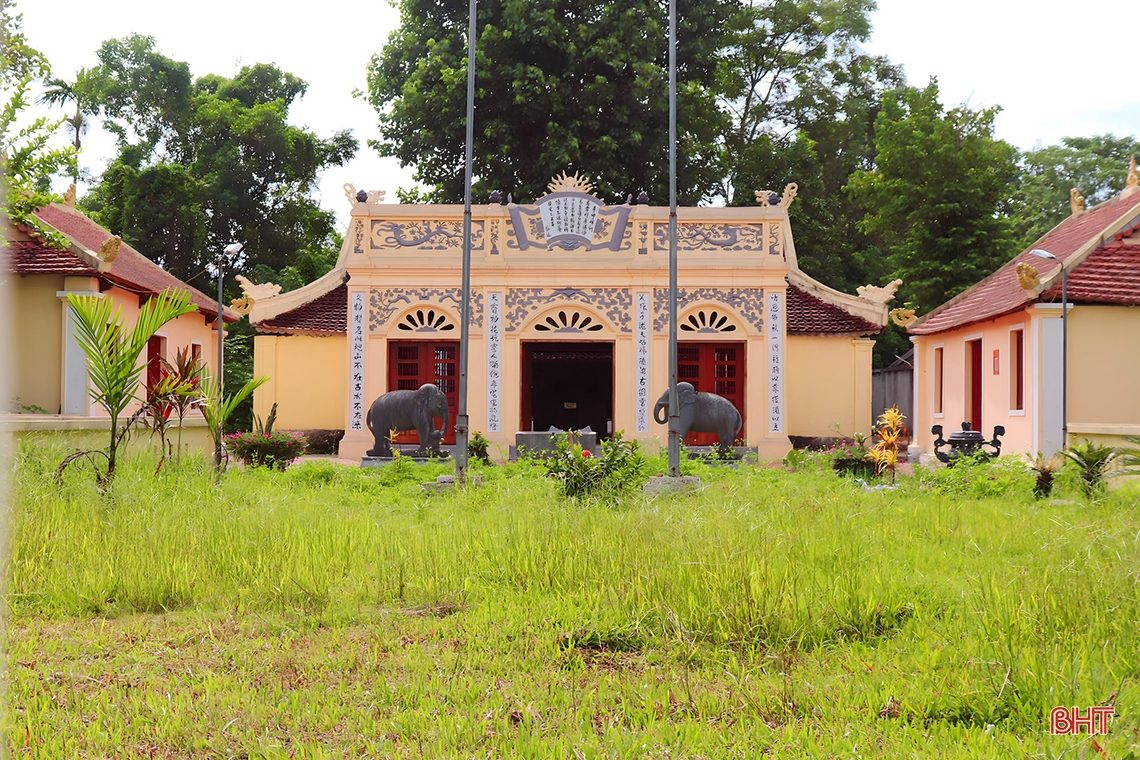
The Áng Phần funerary complex
The clan's main funerary complex: it brings together sixteen ancestors' tombs, including the founder's. Other complexes exist: the Kim Hoa mausoleum, Trai Sơn, Lòi Chim Chim.

The tomb of the Ancestral Mother
It is the tomb of Lady Hoàng Quý Thị, mother of the brothers who went south, at Nghi Long (Nghi Lộc, Nghệ An). It is said that a storm covered her grave with a great mound: the inhabitants said she had been “buried by Heaven”.

The Temple of Literature, in Hanoi
Among the 82 doctors' steles of the Văn Miếu, two bear names from the clan: the one for the examination of 1670, with Đinh Nho Công, and the one for the examination of 1700, with his son Đinh Nho Hoàn. The two steles were erected on the same day, in 1717. According to the plan of the site, they are numbered 45 and 55 and stand in the western garden, in the outer row. If you go to Hanoi, look for them.

1 Đinh Nho Công · Canh Tuất 1670 · stele no. 45 · western garden, outer row, 18th place from the Khuê Văn Các — 2 Đinh Nho Hoàn · Canh Thìn 1700 · stele no. 55 · same row, 10th place, against the Bi Đình pavilion
The clan around the world
Today, members of the clan live far from the homeland: in Paris, where the poet Đinh Nho Tiêu (16th generation) lived; in Oslo, where Đinh Nho Hưng is ambassador; in Cambridge, where Đinh Nho Tâm studied; in the United States, where Đinh Thị Hoa and Đinh Nho Minh studied.
Where does this come from? Đinh Tú Anh's book (2023), the page The Four Tutelary Deities, and, for the temple's listing, the Ministry of Culture's decision of 5 March 2018. The exact location of the Văn Miếu steles is still to be checked against the list of the Hán Nôm Institute.
IX · The wordsA small glossary

Vietnamese is written with our alphabet, but two things set it apart. First, the barred Đ / đ: it is pronounced like the d in “door”, whereas the d without a bar is said z in the North and y in the South. Our name is therefore written Đinh, with the bar. Second, the accents: they are tones, six different melodies. Change the tone and you change the word.
The family and the register
- họ
- The family name, and the whole clan too. Họ Đinh Nho — that is us.
- gia phả
- The clan's register, in which births, marriages and deaths are recorded from the first ancestor onwards.
- đời
- The generation. “Đời 17” is the 17th generation from the founder.
- chi
- The branch. A branch begins when a son founds his own line.
- từ đường
- The ancestral hall, where the tablets are kept and where the family gathers.
- trưởng tộc
- The head of the clan.
- giỗ
- The anniversary of an ancestor's death, and the family meal held that day.
- gia huấn
- The family precept, the rule an ancestor leaves in writing to his descendants. Đinh Nho Hoàn's is in chapter VII.
- tên đệm
- The middle name, between the family name and the given name. Ours is Nho.
Study and the examinations
- nho
- The scholar, and the study of the classic books.
- tiến sĩ
- Doctor, the highest degree, won at the palace examination.
- hoàng giáp
- The second rank of the doctorate.
- cử nhân
- Licentiate, one who passed the regional examination; before the Nguyễn, the word was hương cống.
- Văn Miếu
- The Temple of Literature, in Hanoi.
- Quốc Tử Giám
- The College of the Nation's Sons, the country's first university, next to the Văn Miếu.
- bia tiến sĩ
- The doctors' stele, a stone slab carried by a tortoise, engraved with the names of those who passed.
The virtues
- hiếu
- Filial piety, what one owes to one's parents and ancestors.
- trung
- Loyalty, what one owes to something greater than oneself, to the country, to one's given word.
- đức
- Virtue, that is to say uprightness, not talent.
History and honours
- phúc thần
- “Beneficent spirit”, an ancestor whom the court allows to be honoured as a protector.
- tru di tam tộc
- The extermination of the three lineages, the heaviest penalty in old Vietnam. The related clan of Nghi Long suffered it in 1887.
- Cần Vương
- “Support the king”, the movement of resistance to the French conquest, at the end of the 19th century.
- liệt sĩ
- One who died for the homeland. Several families in the clan count some among their members.
- bút danh
- The pen name. Đinh Nho Diệm's was Quỳnh Dao.
On the map
- làng
- The village.
- xã
- The commune, which groups several villages. In Vietnam, communes sometimes change their names: An Ấp was part of the commune of Sơn Hòa, then of An Hòa Thịnh, and today of Sơn Tiến.
- huyện
- The district. Hương Sơn is a huyện.
If you remember only three words, remember gia phả, giỗ and hiếu: the book, the day, and what links them.