Nho giáo — the Confucian doctrine
A doctrine born in 6th-century-BCE China, for two thousand years the moral and political grammar of East Asia — and the frame within which this family thought, studied and served.
What it is
Neither a religion nor a dogma
Confucianism is often filed among the religions. That is the first point to clarify. It offers no god, no salvation, no afterlife, no revelation; it has neither clergy nor creed. What it offers is a political, social and moral philosophy — an answer to a question of order, in a world that was coming apart.
"You do not yet know how to serve the living: how would you know how to serve the spirits?"
Khổng Tử to his disciple Tử Lộ — Analects, book XI
The sentence denies nothing; it displaces. The spirits are not refuted, they are deferred: something is more urgent, and that urgency is here. Even ancestor worship, the most visibly religious practice of the whole set, is first a rite of memory and continuity — what is owed to the dead is part of what is owed to the living.
Khổng Tử, and how his words were handed on
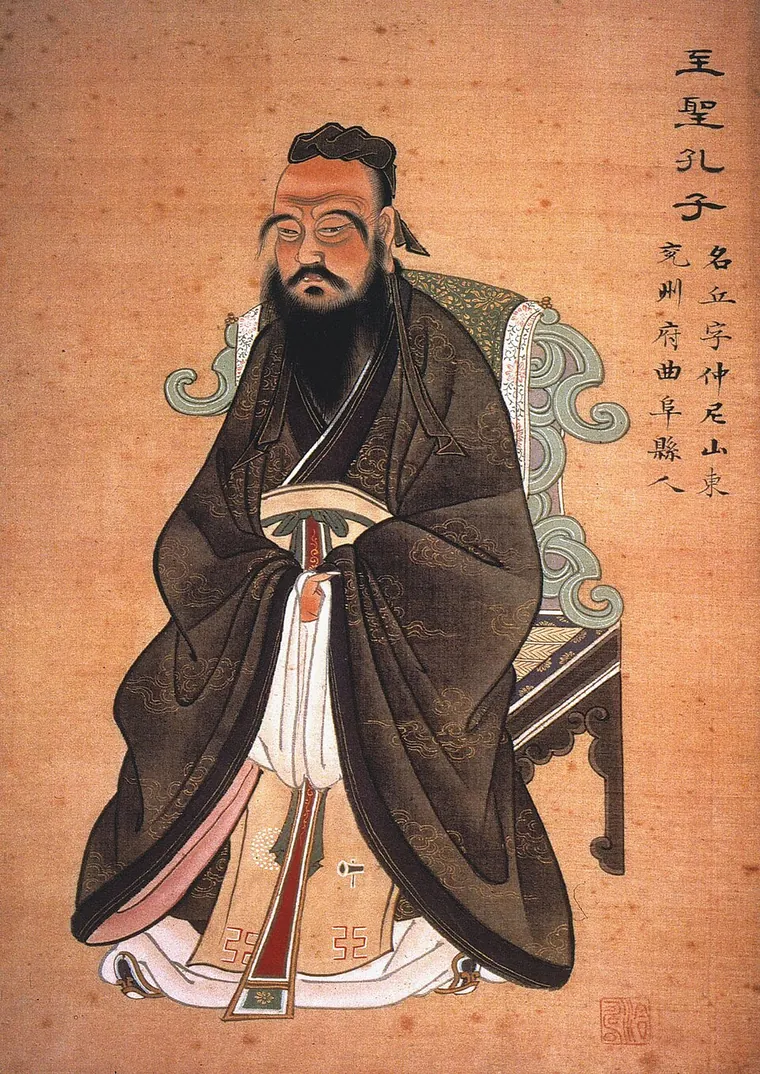

Khổng Tử — Kong Qiu, 551-479 BCE — lived in the principality of Lu during the Spring and Autumn period, as the Zhou order came apart. He served in his own state's administration, then travelled among the neighbouring states to bring his teaching to the princes of his day, and gave his last years to teaching. His words reached us through his disciples: the Luận Ngữ, the "Analects", is the collection of his sayings, gathered after his death by those who had followed him.
His question is not religious but political: how does one restore an order that holds, when the rites are no longer observed and the lords make war? His answer runs neither through law nor through force, but through the moral transformation of those who govern. A virtuous prince is imitated; a coercive one is merely obeyed.
Two great successors, more than a century apart, diverge at the root. Mạnh Tử (Mencius, ≈372-289) holds that human nature is good and needs only cultivating; Tuân Tử (Xunzi, ≈310-235) judges it bad, and makes the rites a discipline that straightens it. Posterity kept Mencius — and that victory decides everything that follows: if man is good, education can make him just, and the scholar becomes the craftsman of government.
- −551 — birth of Khổng Tử in the principality of Lu.
- −136 — under Emperor Wu of the Han (Hán Vũ Đế), chairs are created for the Five Classics: the doctrine becomes a matter of state.
- 605 — the Sui institute the khoa cử examination: office is reached through a written test.
- 1070-1076 — Đại Việt: Văn Miếu (1070), first examination (1075), Quốc Tử Giám (1076).
- 1130-1200 — Zhu Xi recasts the doctrine into a system; his commentary becomes the examination standard.
- 1484 — the first doctors' stelae are raised at the Văn Miếu.
- 1905 — China abolishes the examination.
- 1919 — Vietnam follows: 1915 in the North, 1919 at Huế.
The mechanism
Tu thân — cultivating oneself
Here is the mainspring of the whole doctrine, and what distinguishes it from a mere ethic of obedience. Confucianism does not first ask you to reform the world: it asks you to rectify yourself, and holds that the order of the world follows from there, ring by ring. The Great Learning sets out the chain in eight degrees — each presupposing the one before.
The fifth degree, tu thân, is the hinge — which is why it is set apart above. The Great Learning says it flatly: "from the Son of Heaven down to the common man, all alike must take self-cultivation as the root." Nothing above exempts anyone: the prince is held to the same demand as the farmer, and it is there, precisely, that the doctrine lodges its capacity to judge him.
The Five Constants — Ngũ thường
Cultivate what, exactly? Five dispositions, memorised for centuries. They are not five rules of equal rank: Nhân commands them all, and the other four are the forms it takes.
One sometimes meets a list in which Hiếu, filial piety, replaces Tín among the five. These are in fact two distinct lists. The canonical Five Constants are Nhân, Nghĩa, Lễ, Trí, Tín; Hiếu is not among them — not because it counts for less, but because it counts differently: it is their root. That is the subject of the next paragraph.
Hiếu — the root
Filial piety is not one virtue among others: it is the soil in which the others grow. He who serves his father well will serve his prince well; the family is the school of the kingdom. Hence ancestor worship is a Confucian practice before it is a custom, and keeping a lineage registry is a moral obligation — this site being, in its way, one such exercise.
Social order
Society conceived as a family
From the household to the kingdom, the doctrine does not change its model: it enlarges it. All social life reduces to five bonds, each with its own duty. Four are asymmetrical: one must protect, the other obey. Only one holds between equals.
The Five Relations — Ngũ luân
- Ruler→subject — justice against loyalty
- Father→son — benevolence against filial piety
- Husband→wife — rectitude against submission
- Elder→younger — regard against deference
- Friend↔friend — mutual trust
That asymmetry is not a period failing one could trim away: it is the structure of the doctrine. Social order is conceived as nested relations, unequal but reciprocal — the superior owes as much as the inferior, but he does not owe the same thing.
Chính danh — that words regain their object
"Let the ruler be a ruler, the subject a subject, the father a father, the son a son." Disorder begins when names cease to designate what they name: a ruler who does not govern is no longer a ruler, and nothing more can be asked of him. The rectification of names is the Confucian theory of responsibility — and, turned around, what allows those who govern to be held to account.
Governing
Virtue against penal law
Confucianism was not built in a vacuum: it was built against a rival doctrine, and that is the best way to grasp what it maintains. Facing it, the Legalist school — pháp gia — holds that men do not mend themselves, and that one therefore needs published laws, rewards and punishments applied without exception. It is Legalism that will arm the first empire.
德治 — Đức trị, rule by virtue
Khổng Tử, Mạnh Tử- The ruler is a model — he is imitated.
- Order comes from internalised rites, not from coercion.
- Moral spring: shame, which corrects from within.
- Penal law is an admission of failure, not an instrument.
法治 — Pháp trị, rule by law
Shang Yang, Han Fei- The ruler is an engineer — he tunes a mechanism.
- Order comes from published laws, equal for all.
- Spring: fear of punishment, lure of reward.
- Virtue is judged too rare to be governed with.
"Govern them by regulations, keep them in order by punishments, and the people will avoid wrongdoing without shame. Govern them by virtue, keep them in order by the rites, and they will feel shame, and correct themselves."
Analects, II, 3
Quân tử — the noble man
The word originally meant "prince's son". Khổng Tử subjects it to a decisive shift: the quân tử is no longer he who is born high, but he who conducts himself high. Nobility stops being a station and becomes a conduct — and thereby becomes reachable. That redefinition is among the most consequential in the whole doctrine: it is what makes it thinkable, a thousand years later, that an examination might measure fitness to govern.
What follows is a story of compromise. Under the Han the two schools compound: the state keeps the Legalists' laws and penal code, and gives itself the Confucians' moral language. The mixture has been summed up in a phrase: Confucian without, Legalist within. No East Asian state ever governed by virtue alone.
From an ethic to a state
How a doctrine becomes an administration
Nothing obliged an ethic of virtuous government to become an apparatus, and the chronology is worth recalling: the examination is not an institution of Confucius. It appears in 605, eleven centuries after his death. The doctrine did not produce it: it became its syllabus, which is another matter, and which changed everything for the doctrine.
For the examination performs that transformation: by tying access to office to mastery of a corpus, the state acquires a body of servants formed in one moral language — and the doctrine, in return, gains a machine that reproduces it every generation. The principle is explicit: one enters public office by merit, measured on a script, and not by birth.
Nine books, learnt by heart
State Confucianism rests on a fixed corpus. From Zhu Xi (1130-1200), who recast the doctrine into a system — Neo-Confucianism, Tống Nho — the Four Books become the door of entry, ahead of the Five Classics. It is that version, with Zhu Xi's commentary, that the Vietnamese examinations would test.
Tứ Thư — the Four Books
- Đại Học — the Great Learning
- Trung Dung — the Doctrine of the Mean
- Luận Ngữ — the Analects
- Mạnh Tử — the Mencius
Ngũ Kinh — the Five Classics
- Kinh Thi — the Odes
- Kinh Thư — the Documents
- Kinh Lễ — the Rites
- Kinh Dịch — the Changes
- Xuân Thu — the Spring and Autumn Annals
A candidate did not merely read these texts: he held them by heart, commentaries included, and had to deploy them within an essay of set form. The exercise called for mastery of the corpus and soundness of composition, not personal invention.
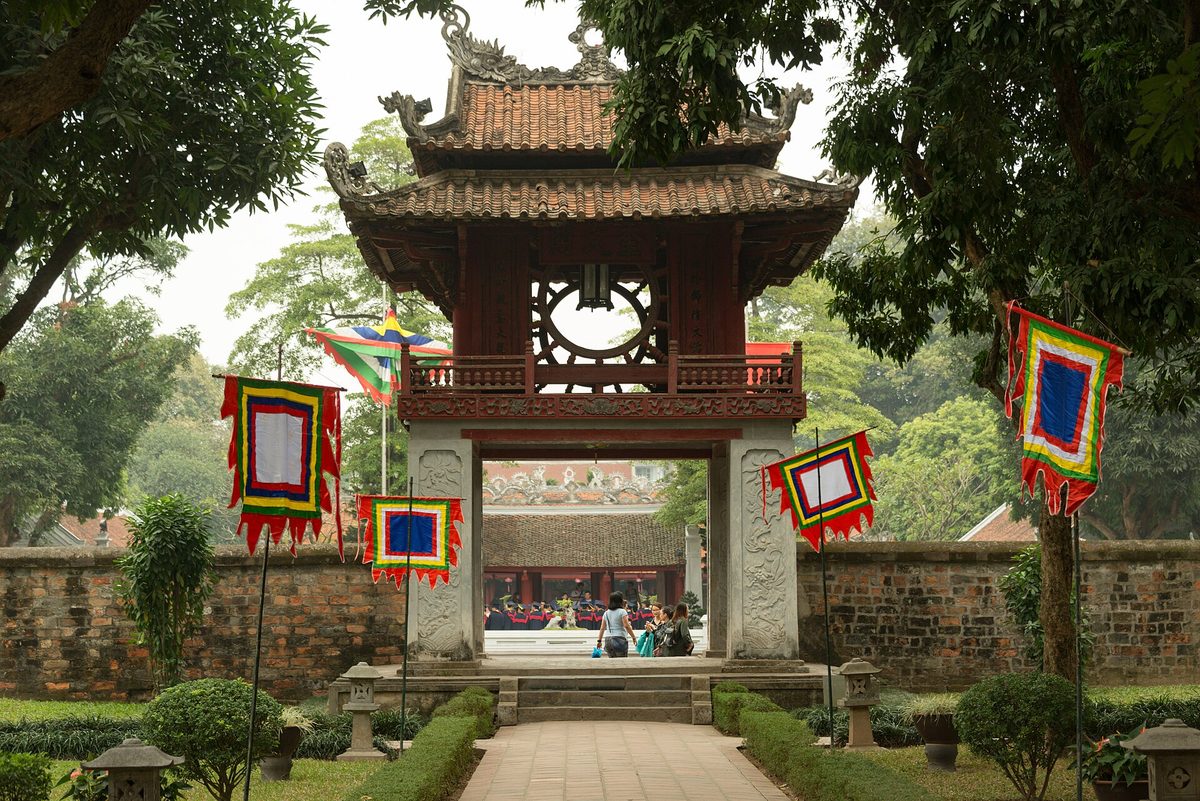
In Vietnam the installation is datable. The Văn Miếu is raised in 1070; the first examination is held in 1075; the Quốc Tử Giám opens in 1076. Under the Lê, in the 15th century, Confucianism becomes orthodoxy: the Hồng Đức code brings law into accord with rite, and from 1484 the doctors' stelae rise at the Văn Miếu — the doctrine gives itself monuments.
Vietnamese Confucianism never reigned alone. The formula tam giáo đồng nguyên — "the three teachings of one source" — states its coexistence with Buddhism and Taoism: one sat examinations as a Confucian, prayed at the pagoda as a Buddhist, consulted the calendar as a Taoist. Doctrinal exclusivity describes daily life poorly.
The arrangement holds for eight centuries. It produces a lettered elite, a literate administration, continuity of the state across dynasties — and a notable social permeability: the farmer's son who passes enters the governing class. Set against the numbers it is little; set against the Europe of the same period it is more.
Beyond Vietnam
One doctrine, four fates
Confucianism is the single common thread of what is sometimes called the "Sinitic world". But each country received it in its own way, and the difference often turns on one precise point: whether or not the examination was adopted — that is, whether or not the doctrine was left to command access to power.
What remains when the apparatus falls
The Confucian state vanished within one generation. The doctrine settled elsewhere: in ancestor worship and the calendar of giỗ; in the standing of the eldest and the authority of the head of lineage; in the lasting prestige of study, which explains why a family of farmers will bleed itself for a son who learns. It is invoked today to explain work ethic, collective sense and respect for elders across East Asia; the inheritance is real, even if its exact share in those traits is hard to measure.
Contemporary Vietnam reassesses it without settling. Temples of literature are restored, Trần Trọng Kim reprinted, the 19th-century scholars rehabilitated; at the same time the critical reading of the old order is maintained. This page does not claim to arbitrate.
What can be said without error: Confucianism is no longer a professed belief, it has become a manner. It shows less in what people assert than in what they do without thinking — an incense stick lit on a fixed date, an elder consulted, a registry kept up.
And here
One family within that history
This lineage does not illustrate the doctrine: it is a particular case, with its own dates. It carries in every man's name the character Nho — 儒, the scholar — adopted in the generation of its first doctor, in 1670. It counts four generations of laureates, two stelae at the Văn Miếu, and a last man received at the examination of 1915, one of the very last.
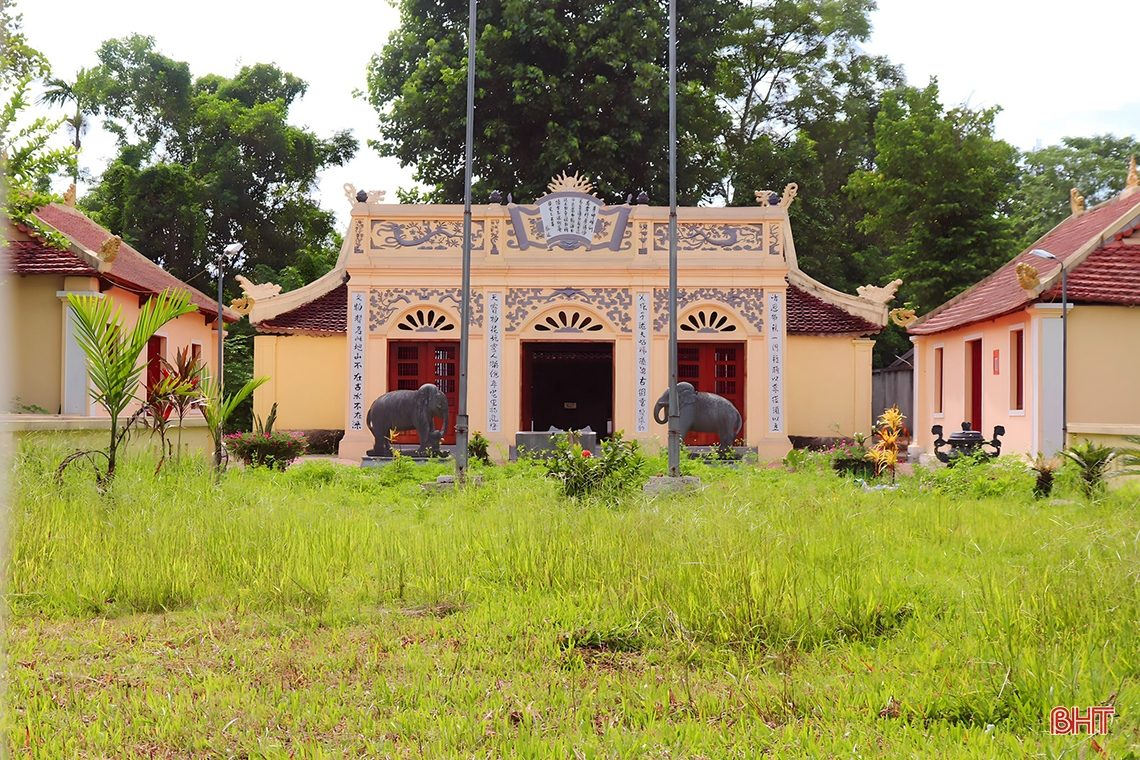
The rest of the site tells that in detail; this page sets out that frame.